
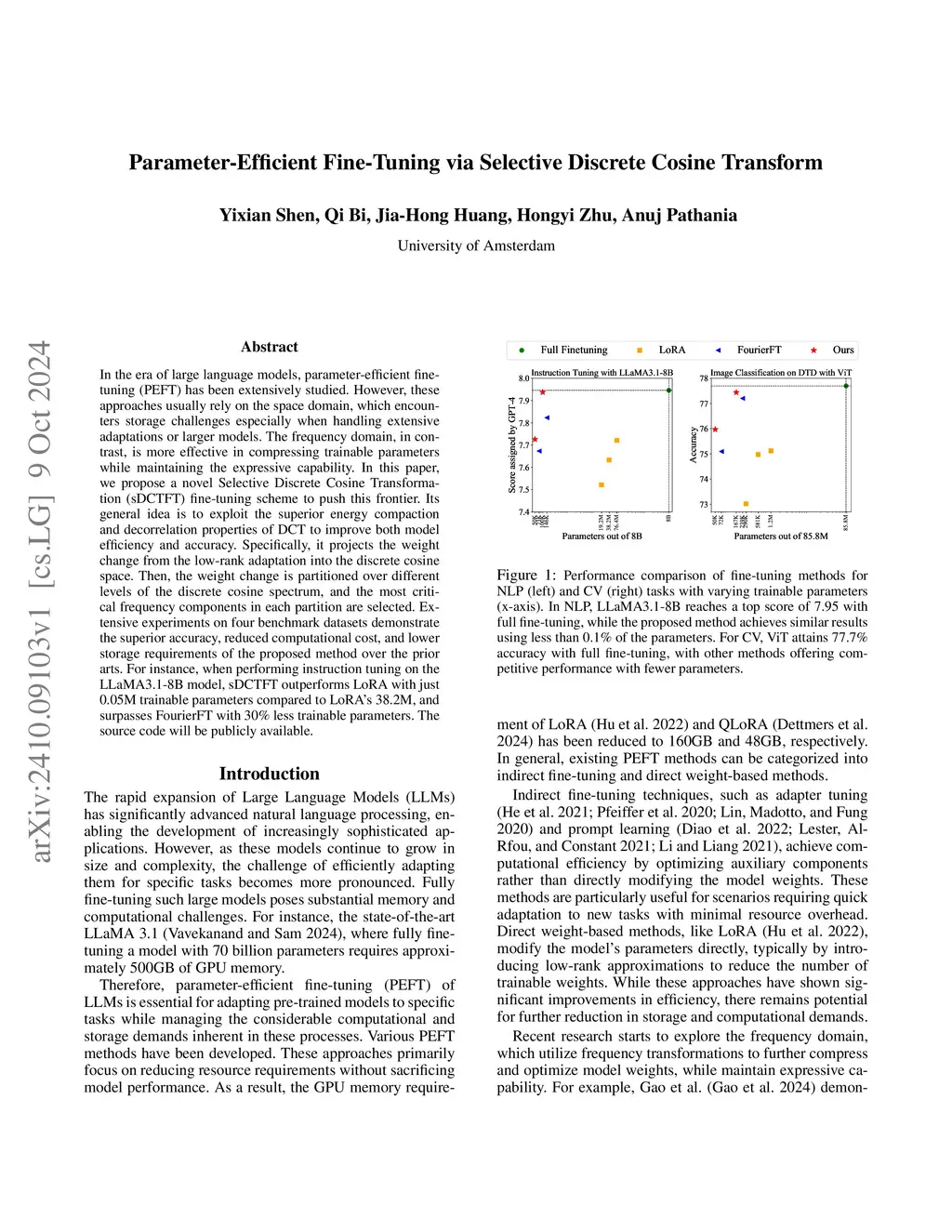
In the era of large language models, parameter-efficient fine-tuning (PEFT) has been extensively studied. However, these approaches usually rely on the space domain, which encounters storage challenges especially when handling extensive adaptations or larger models. The frequency domain, in contrast, is more effective in compressing trainable parameters while maintaining the expressive capability. In this paper, we propose a novel Selective Discrete Cosine Transformation (sDCTFT) fine-tuning scheme to push this frontier. Its general idea is to exploit the superior energy compaction and decorrelation properties of DCT to improve both model efficiency and accuracy. Specifically, it projects the weight change from the low-rank adaptation into the discrete cosine space. Then, the weight change is partitioned over different levels of the discrete cosine spectrum, and the most critical frequency components in each partition are selected. Extensive experiments on four benchmark datasets demonstrate the superior accuracy, reduced computational cost, and lower storage requirements of the proposed method over the prior arts. For instance, when performing instruction tuning on the LLaMA3.1-8B model, sDCTFT outperforms LoRA with just 0.05M trainable parameters compared to LoRA's 38.2M, and surpasses FourierFT with 30\% less trainable parameters. The source code will be publicly available.
View on arXiv