
Mitigating Frequency Bias and Anisotropy in Language Model Pre-Training
with Syntactic Smoothing
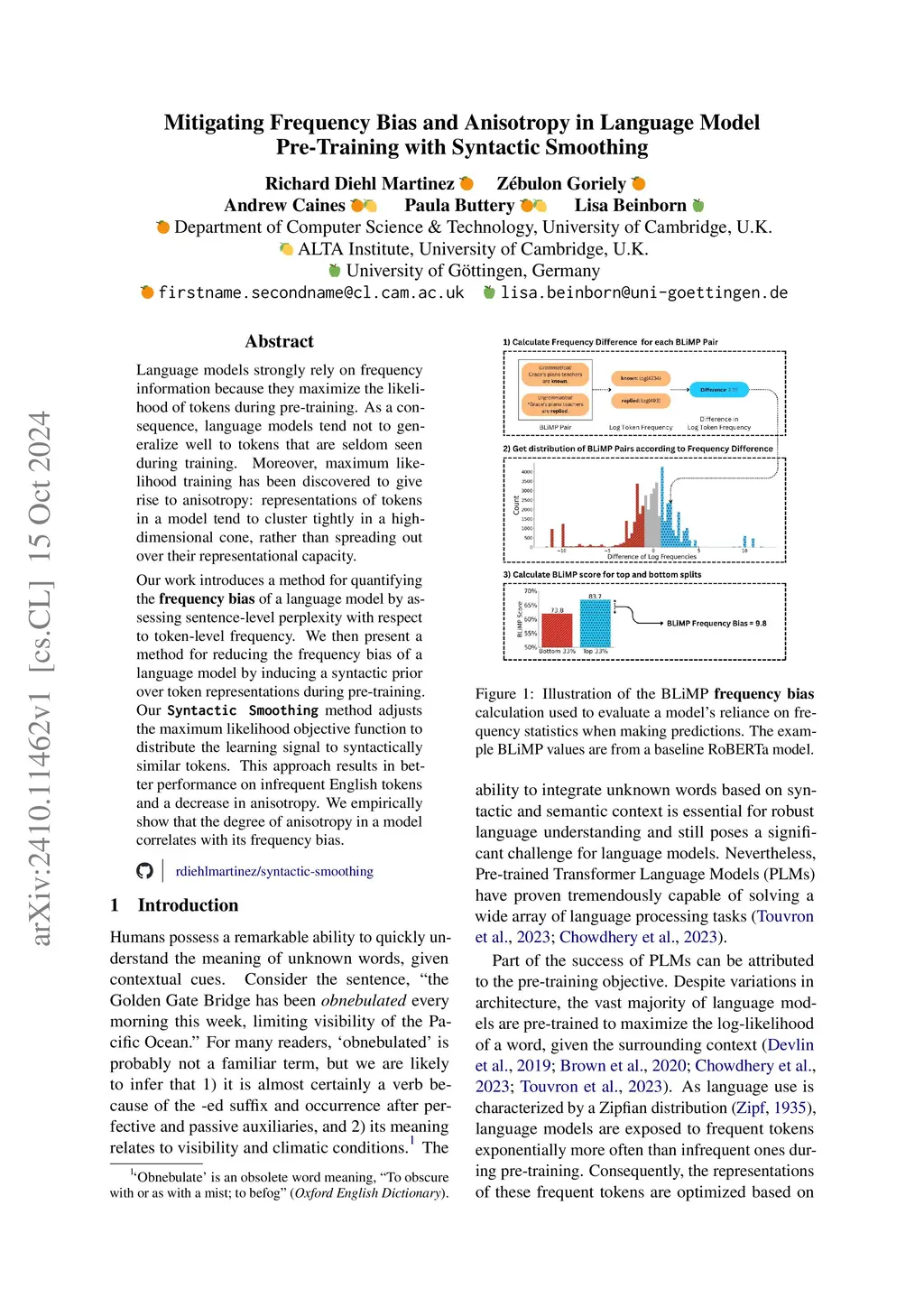
Language models strongly rely on frequency information because they maximize the likelihood of tokens during pre-training. As a consequence, language models tend to not generalize well to tokens that are seldom seen during training. Moreover, maximum likelihood training has been discovered to give rise to anisotropy: representations of tokens in a model tend to cluster tightly in a high-dimensional cone, rather than spreading out over their representational capacity. Our work introduces a method for quantifying the frequency bias of a language model by assessing sentence-level perplexity with respect to token-level frequency. We then present a method for reducing the frequency bias of a language model by inducing a syntactic prior over token representations during pre-training. Our Syntactic Smoothing method adjusts the maximum likelihood objective function to distribute the learning signal to syntactically similar tokens. This approach results in better performance on infrequent English tokens and a decrease in anisotropy. We empirically show that the degree of anisotropy in a model correlates with its frequency bias.
View on arXiv