
Converging to a Lingua Franca: Evolution of Linguistic Regions and Semantics Alignment in Multilingual Large Language Models
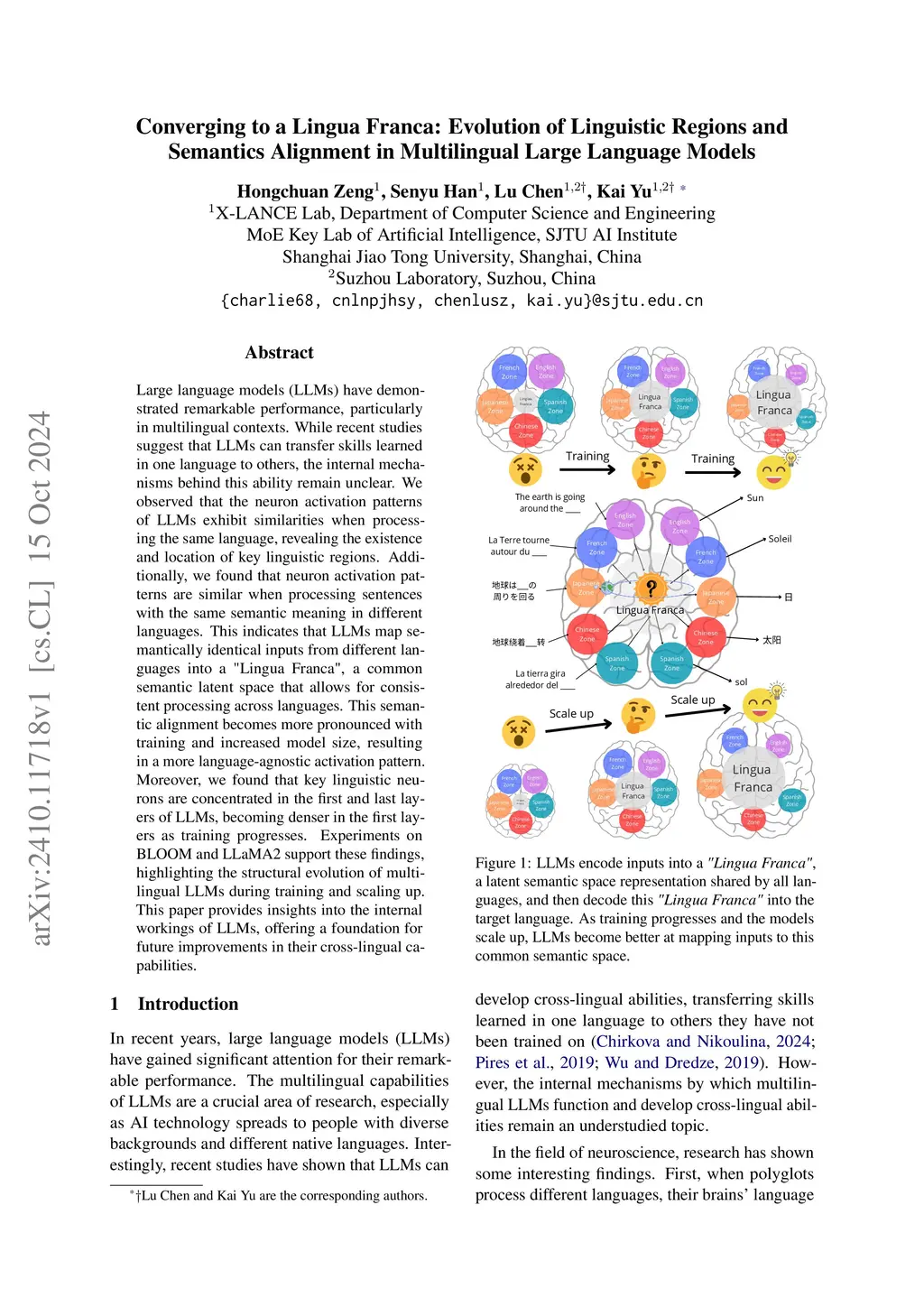
Large language models (LLMs) have demonstrated remarkable performance, particularly in multilingual contexts. While recent studies suggest that LLMs can transfer skills learned in one language to others, the internal mechanisms behind this ability remain unclear. We observed that the neuron activation patterns of LLMs exhibit similarities when processing the same language, revealing the existence and location of key linguistic regions. Additionally, we found that neuron activation patterns are similar when processing sentences with the same semantic meaning in different languages. This indicates that LLMs map semantically identical inputs from different languages into a "Lingua Franca", a common semantic latent space that allows for consistent processing across languages. This semantic alignment becomes more pronounced with training and increased model size, resulting in a more language-agnostic activation pattern. Moreover, we found that key linguistic neurons are concentrated in the first and last layers of LLMs, becoming denser in the first layers as training progresses. Experiments on BLOOM and LLaMA2 support these findings, highlighting the structural evolution of multilingual LLMs during training and scaling up. This paper provides insights into the internal workings of LLMs, offering a foundation for future improvements in their cross-lingual capabilities.
View on arXiv