
MING: A Functional Approach to Learning Molecular Generative Models
- DiffMAI4CE
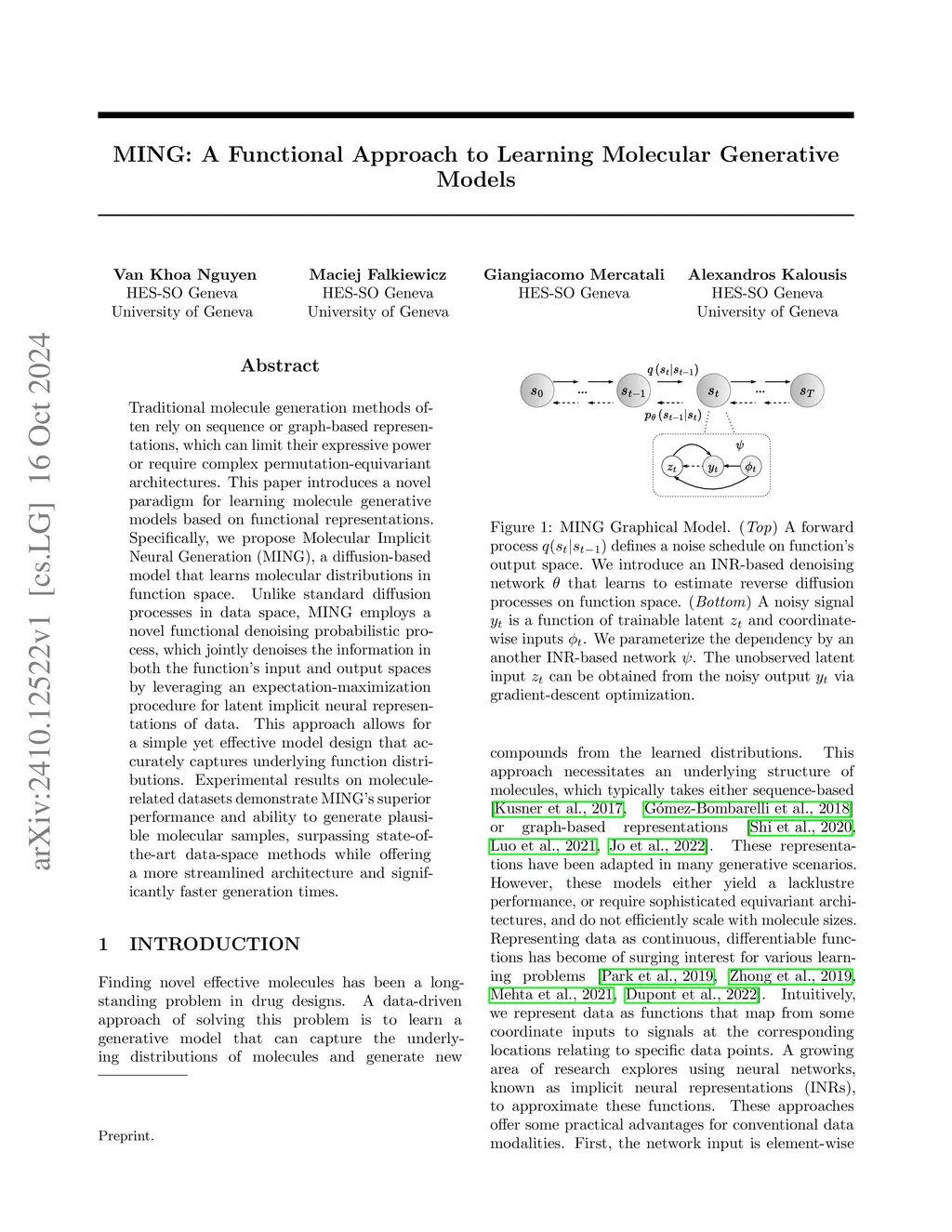
Traditional molecule generation methods often rely on sequence or graph-based representations, which can limit their expressive power or require complex permutation-equivariant architectures. This paper introduces a novel paradigm for learning molecule generative models based on functional representations. Specifically, we propose Molecular Implicit Neural Generation (MING), a diffusion-based model that learns molecular distributions in function space. Unlike standard diffusion processes in data space, MING employs a novel functional denoising probabilistic process, which jointly denoises the information in both the function's input and output spaces by leveraging an expectation-maximization procedure for latent implicit neural representations of data. This approach allows for a simple yet effective model design that accurately captures underlying function distributions. Experimental results on molecule-related datasets demonstrate MING's superior performance and ability to generate plausible molecular samples, surpassing state-of-the-art data-space methods while offering a more streamlined architecture and significantly faster generation times.
View on arXiv