
MM-Eval: A Multilingual Meta-Evaluation Benchmark for LLM-as-a-Judge and Reward Models
- ELMLRM
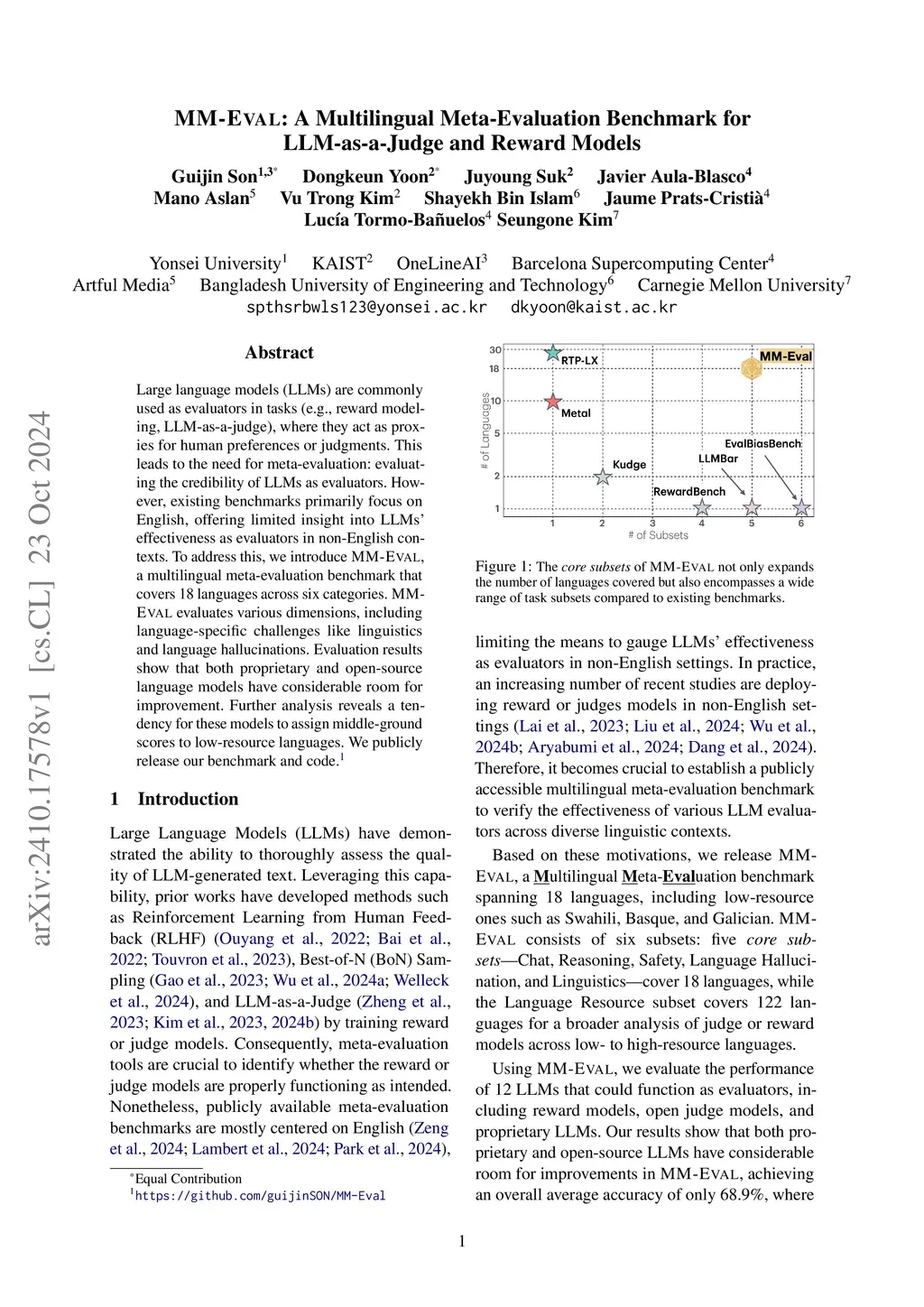
As Large Language Models (LLMs) are now capable of producing fluent and coherent content in languages other than English, it is not imperative to precisely evaluate these non-English outputs. However, when assessing the outputs from mutlilingual LLMs, prior works often employed LLM based evaluators that excel at assessing English outputs, without a thorough examination of whether these evaluators could effectively assess non-English text as well. Moreover, existing benchmarks to test evaluator LLMs (referred to as "meta-evaluation benchmarks") are mostly English-centric. To bridge this gap and examine whether evaluator LLMs can reliably assess the outputs of multilingual LLMs, we introduce MM-Eval, a multilingual meta-evaluation benchmark comprising five core subsets covering 18 languages and a Language Consistency subset spanning 122 languages. A core attribute of MM-Eval is that, instead of merely translating existing English meta-evaluation benchmarks, it is designed with multilingual-specific challenges in mind. Additionally, unlike existing meta-evaluation benchmarks that focus solely on ranking accuracy over pairwise data, MM-Eval also evaluates the consistency and fairness of absolute score values across a wide range of languages. Our results show that existing evaluator LLMs that excel in English contexts have considerable room for improvement when assessing non-English outputs. Furthermore, we find that evaluators are unfair and inconsistent when evaluating lower-resourced languages. Finally, we validate MM-Eval by measuring its correlation with Best-of-N rankings, finding a significantly stronger correlation compared to other meta-evaluation benchmarks. We publicly release our benchmark and code.
View on arXiv