
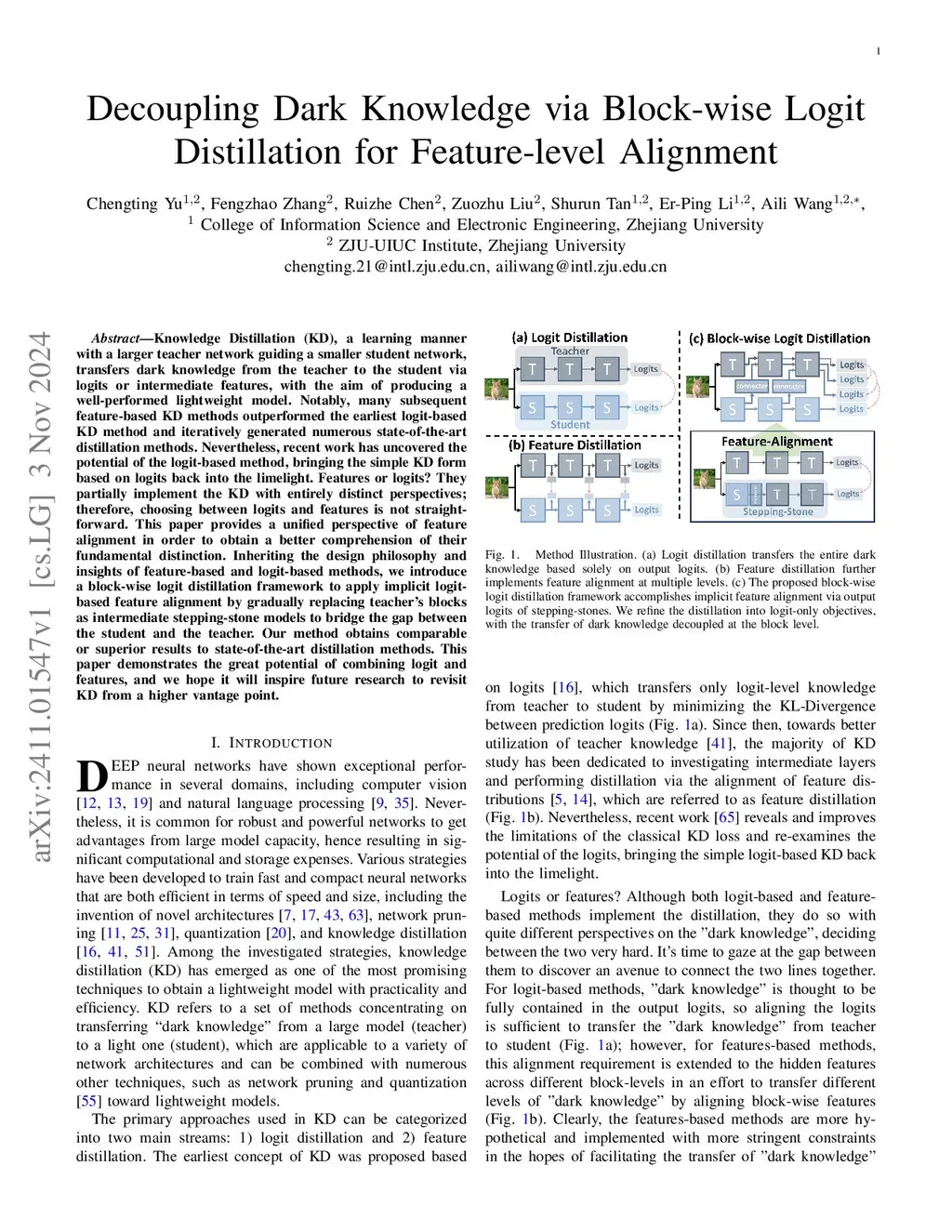
Knowledge Distillation (KD), a learning manner with a larger teacher network guiding a smaller student network, transfers dark knowledge from the teacher to the student via logits or intermediate features, with the aim of producing a well-performed lightweight model. Notably, many subsequent feature-based KD methods outperformed the earliest logit-based KD method and iteratively generated numerous state-of-the-art distillation methods. Nevertheless, recent work has uncovered the potential of the logit-based method, bringing the simple KD form based on logits back into the limelight. Features or logits? They partially implement the KD with entirely distinct perspectives; therefore, choosing between logits and features is not straightforward. This paper provides a unified perspective of feature alignment in order to obtain a better comprehension of their fundamental distinction. Inheriting the design philosophy and insights of feature-based and logit-based methods, we introduce a block-wise logit distillation framework to apply implicit logit-based feature alignment by gradually replacing teacher's blocks as intermediate stepping-stone models to bridge the gap between the student and the teacher. Our method obtains comparable or superior results to state-of-the-art distillation methods. This paper demonstrates the great potential of combining logit and features, and we hope it will inspire future research to revisit KD from a higher vantage point.
View on arXiv