
Planning for quasi-static manipulation tasks via an intrinsic haptic metric: a book insertion case study
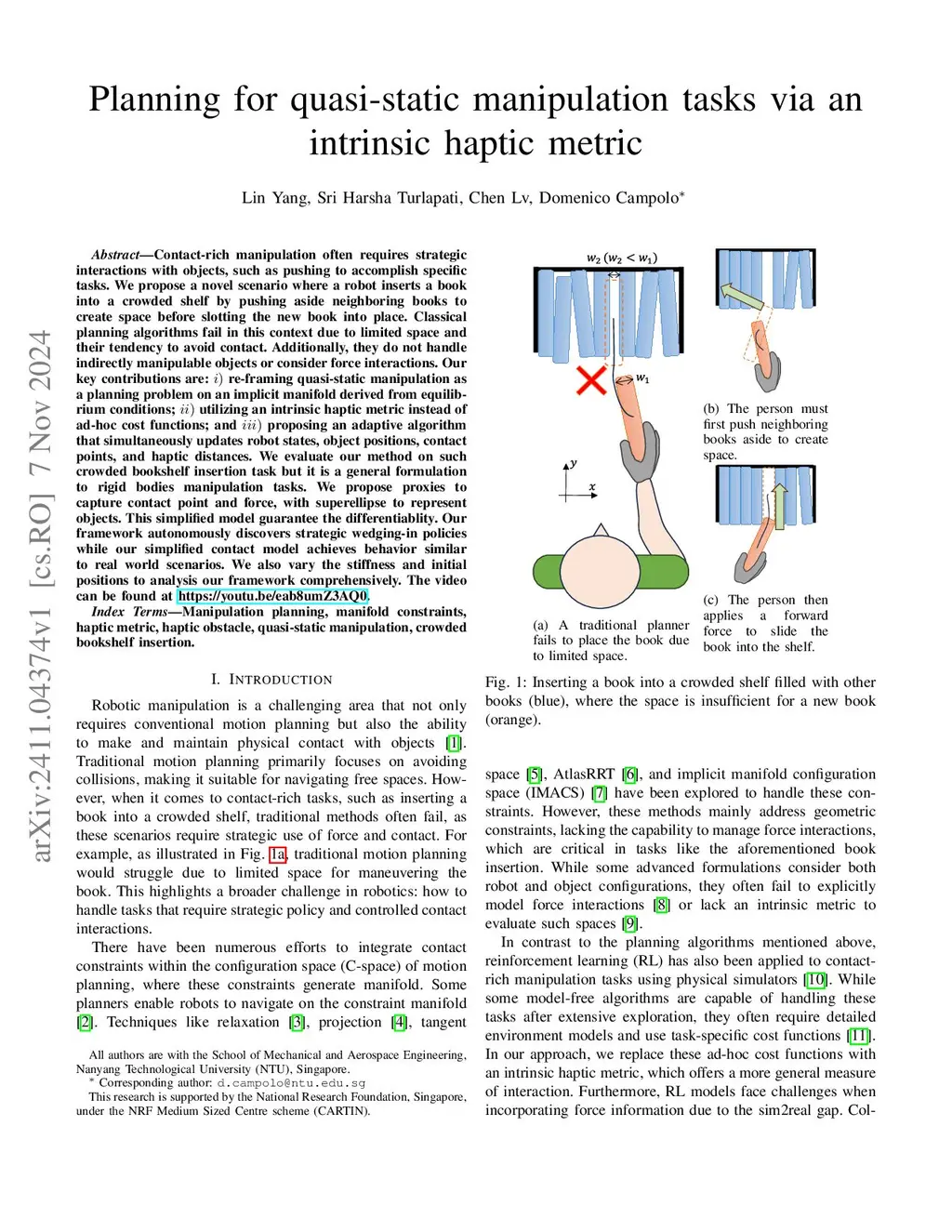
Contact-rich manipulation often requires strategic interactions with objects, such as pushing to accomplish specific tasks. We propose a novel scenario where a robot inserts a book into a crowded shelf by pushing aside neighboring books to create space before slotting the new book into place. Classical planning algorithms fail in this context due to limited space and their tendency to avoid contact. Additionally, they do not handle indirectly manipulable objects or consider force interactions. Our key contributions are: i) reframing quasi-static manipulation as a planning problem on an implicit manifold derived from equilibrium conditions; ii) utilizing an intrinsic haptic metric instead of ad-hoc cost functions; and iii) proposing an adaptive algorithm that simultaneously updates robot states, object positions, contact points, and haptic distances. We evaluate our method on a crowded bookshelf insertion task, and it can be generally applied to rigid body manipulation tasks. We propose proxies to capture contact points and forces, with superellipses to represent objects. This simplified model guarantees differentiability. Our framework autonomously discovers strategic wedging-in policies while our simplified contact model achieves behavior similar to real world scenarios. We also vary the stiffness and initial positions to analyze our framework comprehensively. The video can be found atthis https URL.
View on arXiv