
Understanding Internal Representations of Recommendation Models with Sparse Autoencoders
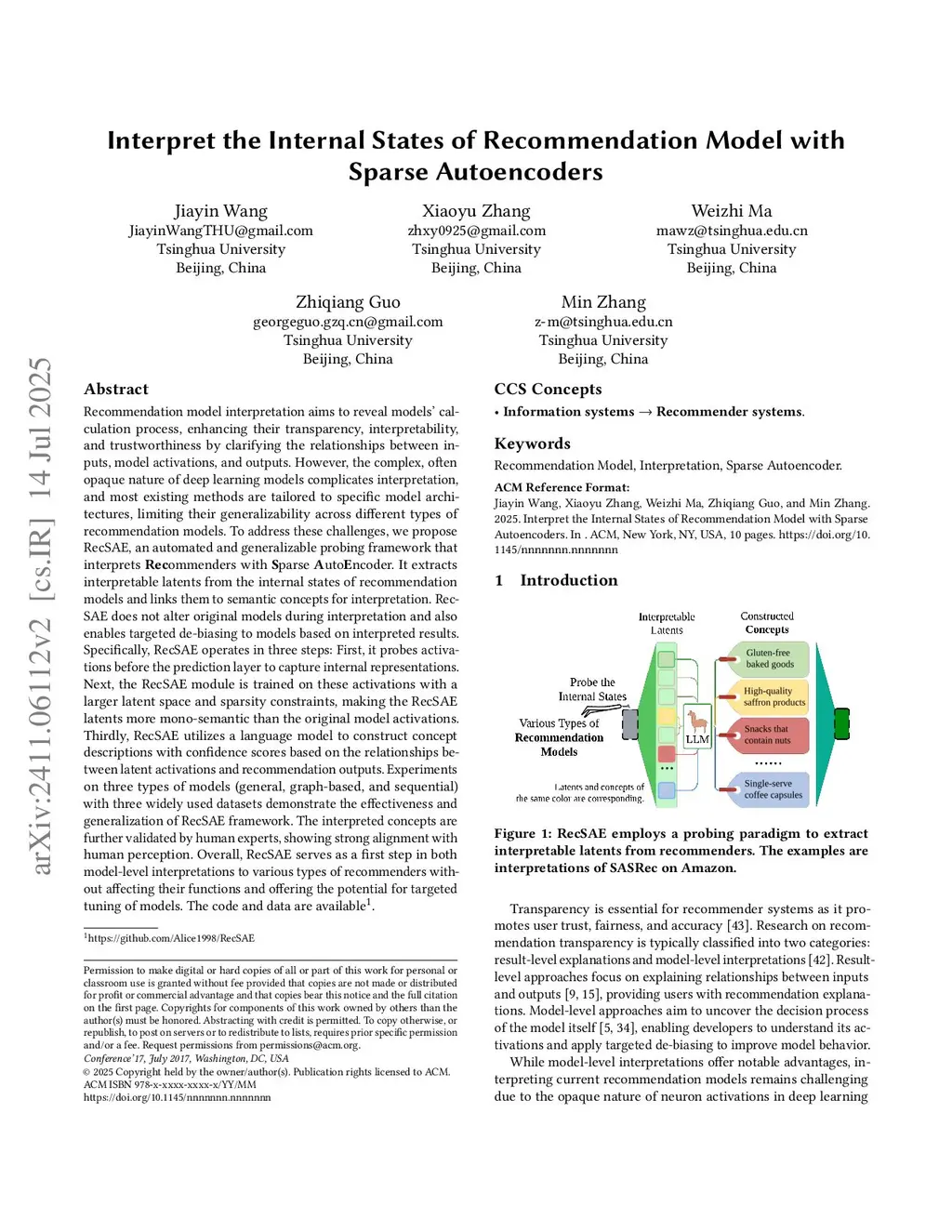
Recommendation model interpretation aims to reveal the relationships between inputs, model internal representations and outputs to enhance the transparency, interpretability, and trustworthiness of recommendation systems. However, the inherent complexity and opacity of deep learning models pose challenges for model-level interpretation. Moreover, most existing methods for interpreting recommendation models are tailored to specific architectures or model types, limiting their generalizability across different types of recommenders. In this paper, we propose RecSAE, a generalizable probing framework that interprets Recommendation models with Sparse AutoEncoders. The framework extracts interpretable latents from the internal representations of recommendation models, and links them to semantic concepts for interpretations. It does not alter original models during interpretations and also enables targeted tuning to models. Experiments on three types of recommendation models (general, graph-based, sequential) with four widely used public datasets demonstrate the effectiveness and generalization of RecSAE framework. The interpreted concepts are further validated by human experts, showing strong alignment with human perception. Overall, RecSAE serves as a novel step in both model-level interpretations to various types of recommendation models without affecting their functions and offering potential for targeted tuning of models.
View on arXiv