
Counterfactual Uncertainty Quantification of Factual Estimand of Efficacy from Before-and-After Treatment Repeated Measures Randomized Controlled Trials
- CML
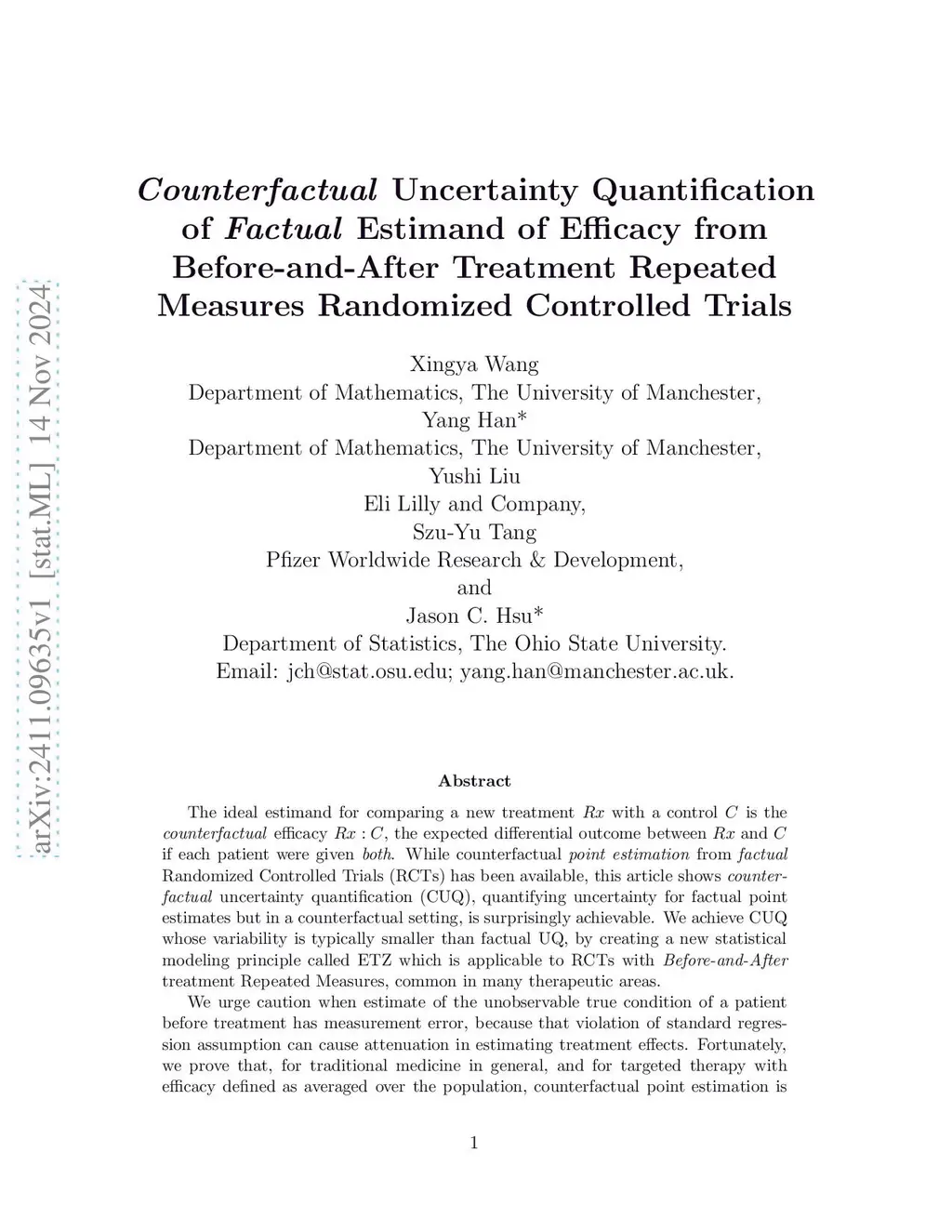
This article quantifies the uncertainty reduction achievable for \textit{counterfactual} estimand, and cautions against potential bias when the estimand uses Digital Twins. Posed by Neyman (1923a) who showed unbiased \textit{point estimation} from designed \textit{factual} experiments is possible, \textit{counterfactual} uncertainty quantification (CUQ) remained an open challenge for about one hundred years. The \textit{counterfactual} efficacy we focus on is the ideal estimand for comparing treatment with control , the expected outcome differential if each patient received \textit{both} and . Enabled by our new statistical modeling principle called ETZ, we show CUQ is achievable in Randomized Controlled Trials (RCTs) with \textit{Before-and-After} Repeated Measures, common in many therapeutic areas. The CUQ we are able to achieve typically has lower variability than factual UQ.We caution against using predictors with measurement error, which violates regression assumptions and can cause \textit{attenuation} bias in estimating treatment effects. For traditional medicine and population-averaged targeted therapy, counterfactual point estimation remains unbiased. However, in both Real Human and Digital Twin approaches, estimating effects in \emph{subgroups} may suffer attenuation bias.
View on arXiv