
FAST-Splat: Fast, Ambiguity-Free Semantics Transfer in Gaussian Splatting
- 3DGSVLM
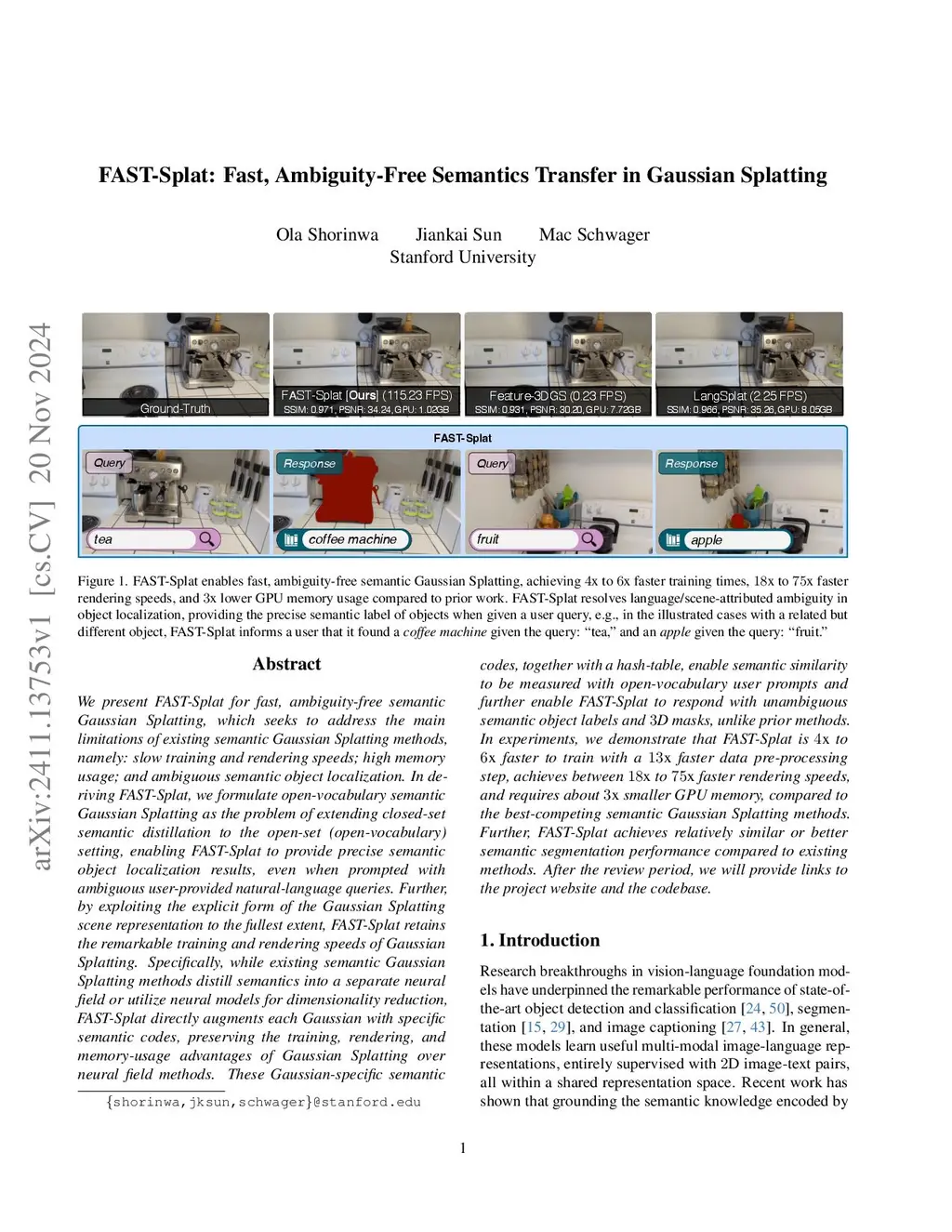
We present FAST-Splat for fast, ambiguity-free semantic Gaussian Splatting, which seeks to address the main limitations of existing semantic Gaussian Splatting methods, namely: slow training and rendering speeds; high memory usage; and ambiguous semantic object localization. We take a bottom-up approach in deriving FAST-Splat, dismantling the limitations of closed-set semantic distillation to enable open-set (open-vocabulary) semantic distillation. Ultimately, this key approach enables FAST-Splat to provide precise semantic object localization results, even when prompted with ambiguous user-provided natural-language queries. Further, by exploiting the explicit form of the Gaussian Splatting scene representation to the fullest extent, FAST-Splat retains the remarkable training and rendering speeds of Gaussian Splatting. Precisely, while existing semantic Gaussian Splatting methods distill semantics into a separate neural field or utilize neural models for dimensionality reduction, FAST-Splat directly augments each Gaussian with specific semantic codes, preserving the training, rendering, and memory-usage advantages of Gaussian Splatting over neural field methods. These Gaussian-specific semantic codes, together with a hash-table, enable semantic similarity to be measured with open-vocabulary user prompts and further enable FAST-Splat to respond with unambiguous semantic object labels and D masks, unlike prior methods. In experiments, we demonstrate that FAST-Splat is 6x to 8x faster to train, achieves between 18x to 51x faster rendering speeds, and requires about 6x smaller GPU memory, compared to the best-competing semantic Gaussian Splatting methods. Further, FAST-Splat achieves relatively similar or better semantic segmentation performance compared to existing methods. After the review period, we will provide links to the project website and the codebase.
View on arXiv