
Federated Continual Graph Learning
- FedML
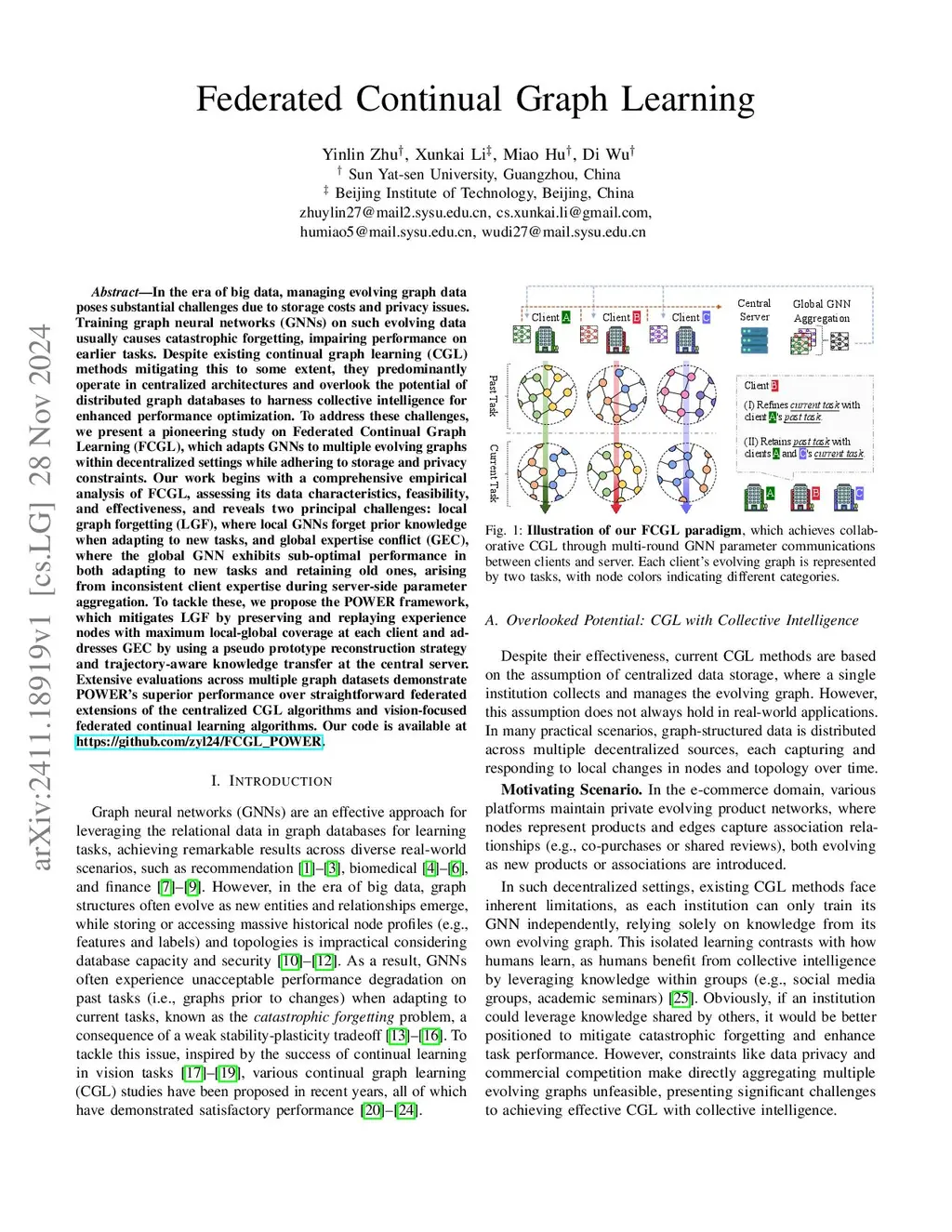
In the era of big data, managing evolving graph data poses substantial challenges due to storage costs and privacy issues. Training graph neural networks (GNNs) on such evolving data usually causes catastrophic forgetting, impairing performance on earlier tasks. Despite existing continual graph learning (CGL) methods mitigating this to some extent, they rely on centralized architectures and ignore the potential of distributed graph databases to leverage collective intelligence. To address these challenges, we present a pioneering study on Federated Continual Graph Learning (FCGL), which adapts GNNs to multiple evolving graphs within decentralized settings while adhering to storage and privacy constraints. Our work begins with a comprehensive empirical analysis of FCGL, assessing its data characteristics, feasibility, and effectiveness, and reveals two non-trivial challenges: local graph forgetting (LGF), where local GNNs forget prior knowledge when adapting to new tasks, and global expertise conflict (GEC), where the global GNN exhibits sub-optimal performance in both adapting to new tasks and retaining old ones, arising from inconsistent client expertise during server-side parameter aggregation. To tackle these, we propose the POWER framework, which mitigates LGF by preserving and replaying experience nodes with maximum local-global coverage at each client and addresses GEC by using a pseudo prototype reconstruction strategy and trajectory-aware knowledge transfer at the central server. Experiments on various graph datasets demonstrate POWER's superiority over federated adaptations of CGL baselines and vision-centric federated continual learning approaches.
View on arXiv