
Friend or Foe? Harnessing Controllable Overfitting for Anomaly Detection
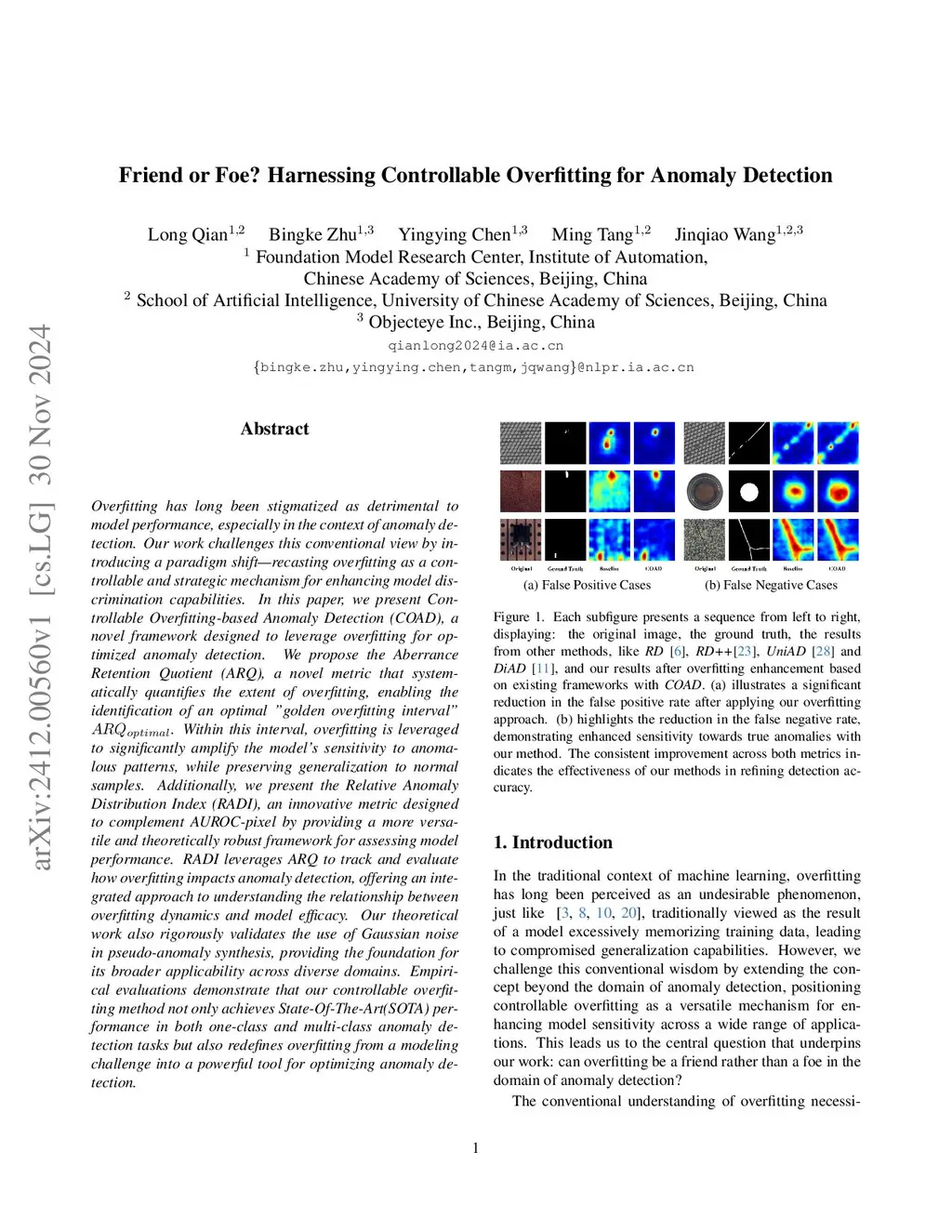
Overfitting has traditionally been viewed as detrimental to anomaly detection, where excessive generalization often limits models' sensitivity to subtle anomalies. Our work challenges this conventional view by introducing Controllable Overfitting-based Anomaly Detection (COAD), a novel framework that strategically leverages overfitting to enhance anomaly discrimination capabilities. We propose the Aberrance Retention Quotient (ARQ), a novel metric that systematically quantifies the extent of overfitting, enabling the identification of an optimal golden overfitting interval wherein model sensitivity to anomalies is maximized without sacrificing generalization. To comprehensively capture how overfitting affects detection performance, we further propose the Relative Anomaly Distribution Index (RADI), a metric superior to traditional AUROC by explicitly modeling the separation between normal and anomalous score distributions. Theoretically, RADI leverages ARQ to track and evaluate how overfitting impacts anomaly detection, offering an integrated approach to understanding the relationship between overfitting dynamics and model efficacy. We also rigorously validate the statistical efficacy of Gaussian noise as pseudo-anomaly generators, reinforcing the method's broad applicability. Empirical evaluations demonstrate that our controllable overfitting method achieves State-Of-The-Art(SOTA) performance in both one-class and multi-class anomaly detection tasks, thus redefining overfitting as a powerful strategy rather than a limitation.
View on arXiv