
Towards Adaptive Mechanism Activation in Language Agent
- LLMAGAI4CE
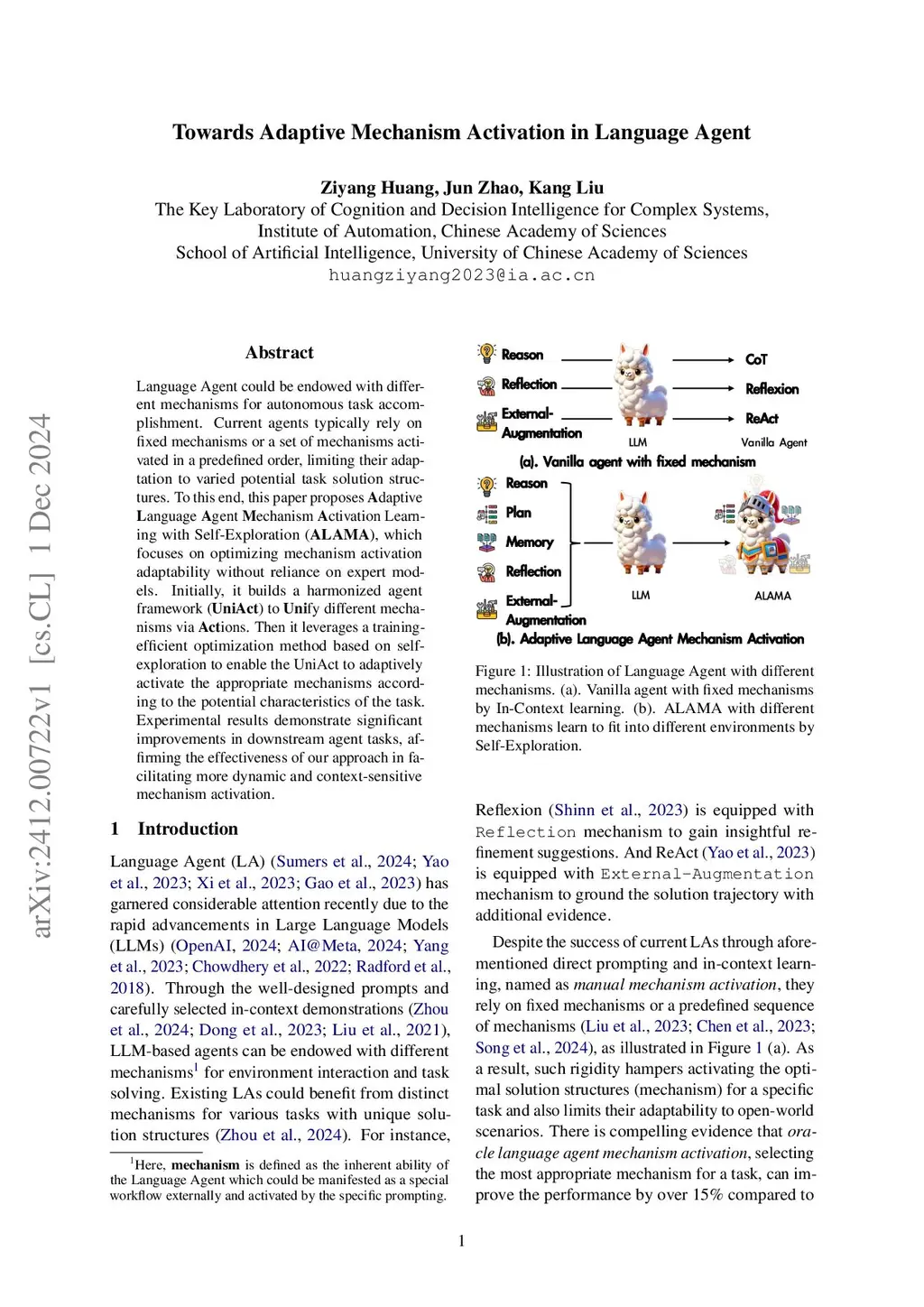
Language Agent could be endowed with different mechanisms for autonomous task accomplishment. Current agents typically rely on fixed mechanisms or a set of mechanisms activated in a predefined order, limiting their adaptation to varied potential task solution structures. To this end, this paper proposes \textbf{A}daptive \textbf{L}anguage \textbf{A}gent \textbf{M}echanism \textbf{A}ctivation Learning with Self-Exploration (\textbf{ALAMA}), which focuses on optimizing mechanism activation adaptability without reliance on expert models. Initially, it builds a harmonized agent framework (\textbf{UniAct}) to \textbf{Uni}fy different mechanisms via \textbf{Act}ions. Then it leverages a training-efficient optimization method based on self-exploration to enable the UniAct to adaptively activate the appropriate mechanisms according to the potential characteristics of the task. Experimental results demonstrate significant improvements in downstream agent tasks, affirming the effectiveness of our approach in facilitating more dynamic and context-sensitive mechanism activation.
View on arXiv