
Adapting Large Language Models to Log Analysis with Interpretable Domain Knowledge
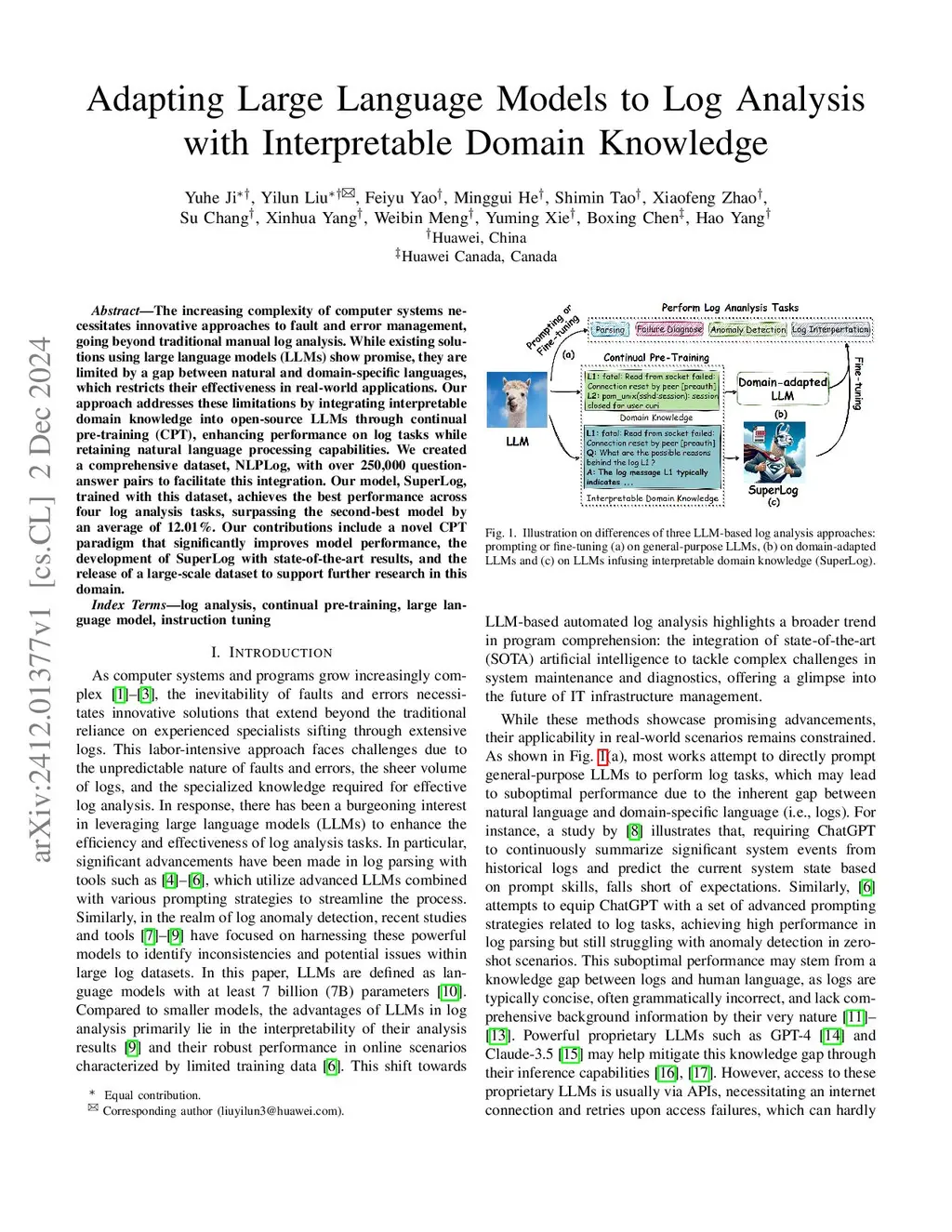
Log analysis represents a critical sub-domain within AI applications that facilitates automatic approaches to fault and error management of large-scaled software systems, saving labors of traditional manual methods. While existing solutions using large language models (LLMs) show promise, they are limited by a significant domain gap between natural and log languages (the latter contains rich domain-specific tokens such as status codes, IP addresses, resource pathes), which restricts their effectiveness in real-world applications. However, directly adapting general-purpose LLMs to log analysis using raw logs may degrade their performance due to inconsistent token distribution. In this paper, we present a domain adaptation approach that addresses these limitations by integrating interpretable domain knowledge into open-source LLMs through continual pre-training (CPT), which bridges this domain gap by adapting LLMs on interpretable natural texts with log knowledge (instead of raw logs) to reduce distribution discrepancy. To achieve this, we developed NLPLog, a comprehensive dataset containing over 250,000 question-answer pairs on log-related knowledge. Our resulting model, SuperLog, achieves the best performance across four log analysis tasks, with an average accuracy improvement of 12.01% over the second-best model. Ablation study also suggests advantages of domain adaption using interpretable log knowledge over using raw logs.
View on arXiv