
Unbiased General Annotated Dataset Generation
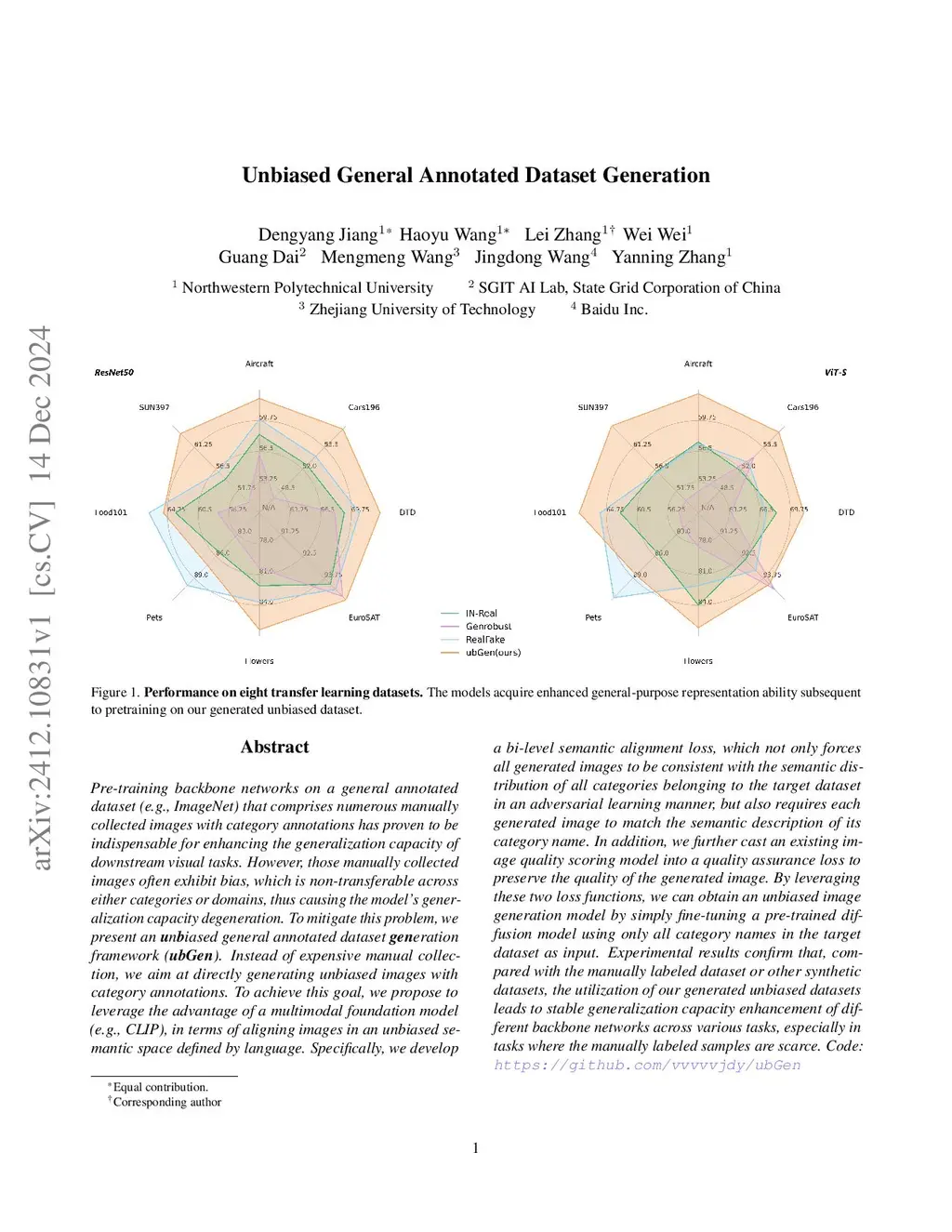
Pre-training backbone networks on a general annotated dataset (e.g., ImageNet) that comprises numerous manually collected images with category annotations has proven to be indispensable for enhancing the generalization capacity of downstream visual tasks. However, those manually collected images often exhibit bias, which is non-transferable across either categories or domains, thus causing the model's generalization capacity degeneration. To mitigate this problem, we present an unbiased general annotated dataset generation framework (ubGen). Instead of expensive manual collection, we aim at directly generating unbiased images with category annotations. To achieve this goal, we propose to leverage the advantage of a multimodal foundation model (e.g., CLIP), in terms of aligning images in an unbiased semantic space defined by language. Specifically, we develop a bi-level semantic alignment loss, which not only forces all generated images to be consistent with the semantic distribution of all categories belonging to the target dataset in an adversarial learning manner, but also requires each generated image to match the semantic description of its category name. In addition, we further cast an existing image quality scoring model into a quality assurance loss to preserve the quality of the generated image. By leveraging these two loss functions, we can obtain an unbiased image generation model by simply fine-tuning a pre-trained diffusion model using only all category names in the target dataset as input. Experimental results confirm that, compared with the manually labeled dataset or other synthetic datasets, the utilization of our generated unbiased datasets leads to stable generalization capacity enhancement of different backbone networks across various tasks, especially in tasks where the manually labeled samples are scarce.
View on arXiv