
Cultural Dimensions of AI Perception: Charting Expectations, Risks, Benefits, Tradeoffs, and Value in Germany and China
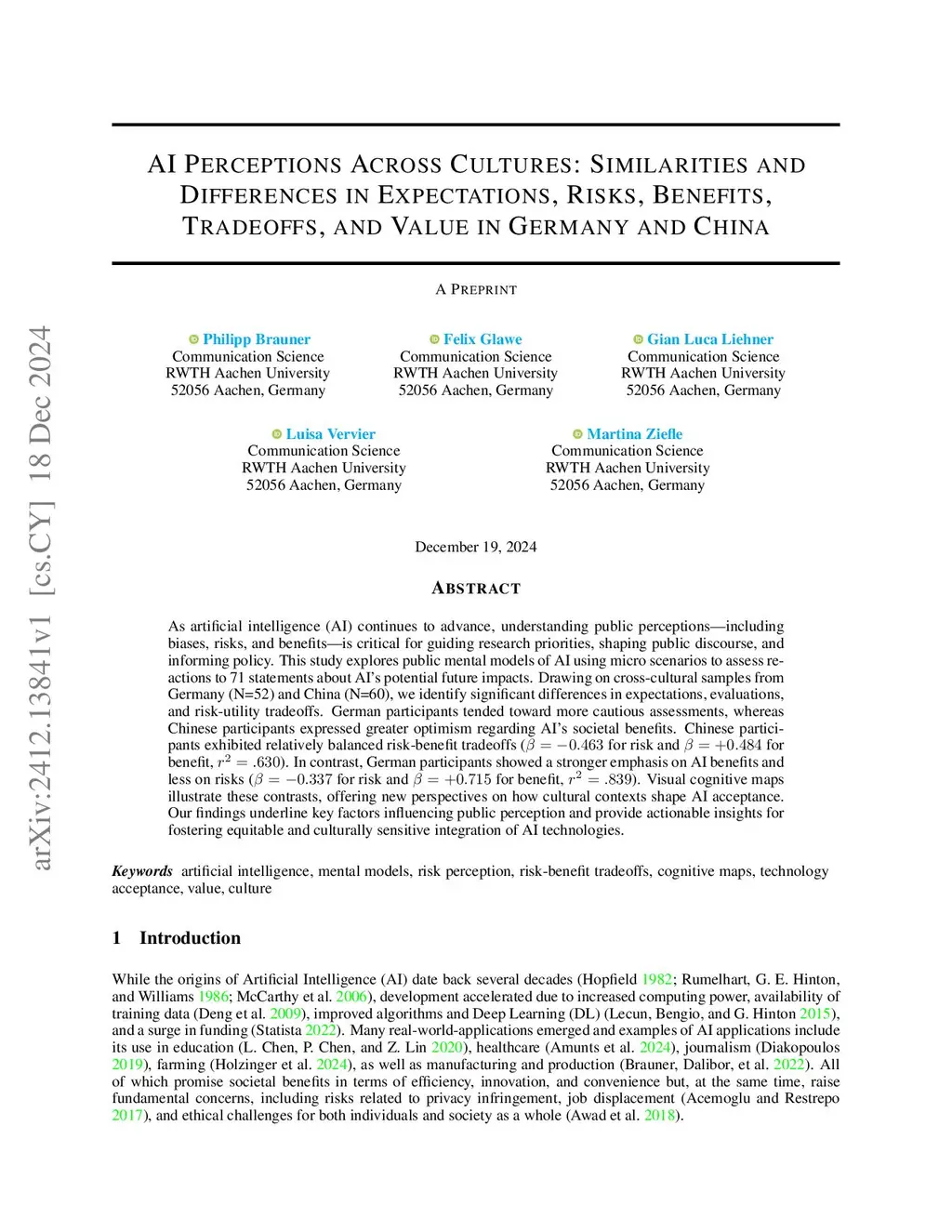
As artificial intelligence (AI) continues to advance, understanding public perceptions -- including biases, risks, and benefits -- is essential for guiding research priorities and AI alignment, shaping public discourse, and informing policy. This exploratory study investigates cultural differences in mental models of AI using 71 imaginaries of AI's potential futures. Drawing on cross-cultural convenience samples from Germany (N=52) and China (N=60), we identify significant differences in expectations, evaluations, and risk-benefit tradeoffs. Participants from Germany generally provided more cautious assessments, whereas participants from China expressed greater optimism regarding AI's societal benefits. Chinese participants exhibited relatively balanced risk-benefit tradeoffs ( for risk and for benefit, ). In contrast, German participants placed greater emphasis on AI's benefits and comparatively less on risks ( for risk and for benefit, ). Visual cognitive maps illustrate these contrasts, offering new perspectives on how cultural contexts shape AI acceptance. Our findings highlight key factors influencing public perception and provide insights for aligning AI with societal values and promoting equitable and culturally sensitive integration of AI technologies.
View on arXiv