
Embodied Image Quality Assessment for Robotic Intelligence
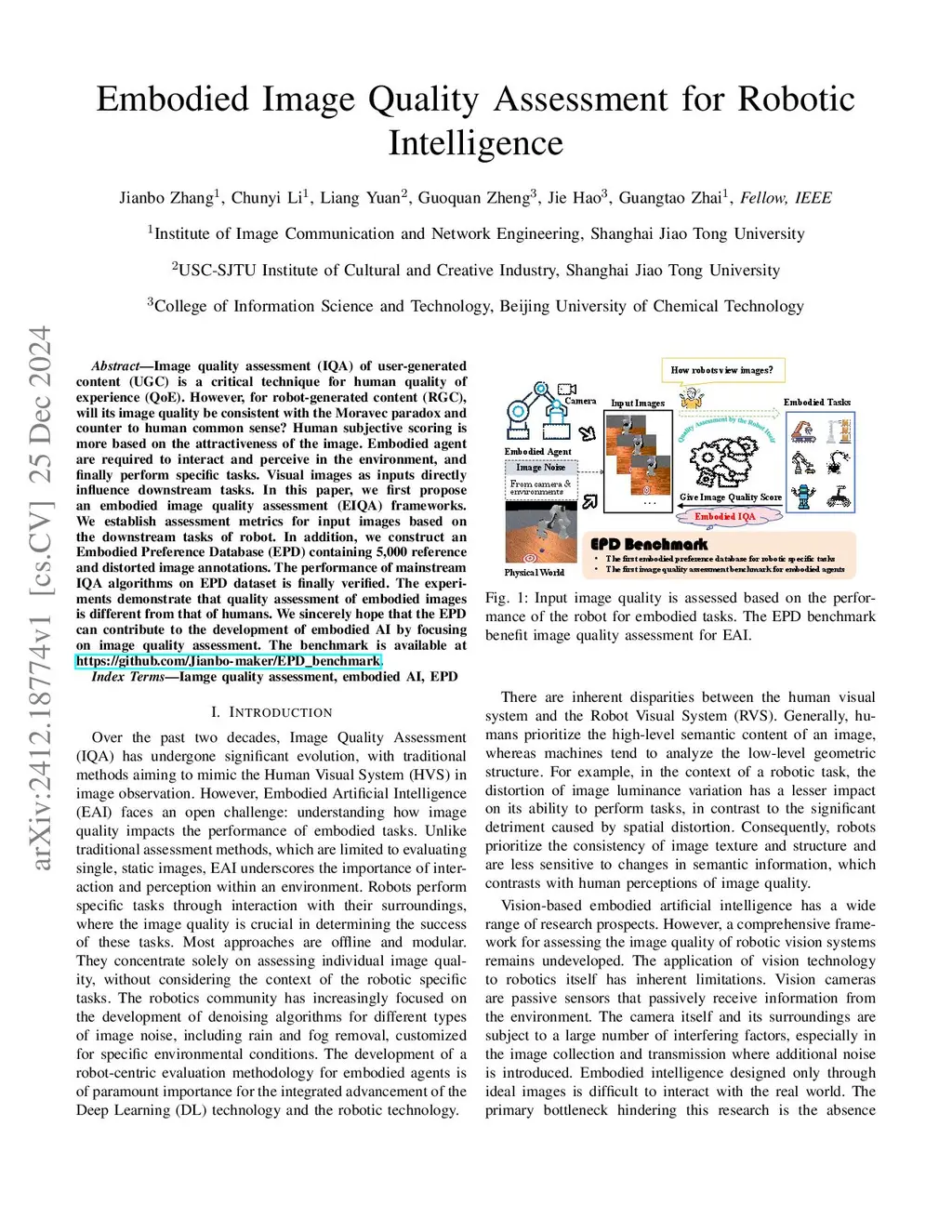
Image Quality Assessment (IQA) of User-Generated Content (UGC) is a critical technique for human Quality of Experience (QoE). However, does the the image quality of Robot-Generated Content (RGC) demonstrate traits consistent with the Moravec paradox, potentially conflicting with human perceptual norms? Human subjective scoring is more based on the attractiveness of the image. Embodied agent are required to interact and perceive in the environment, and finally perform specific tasks. Visual images as inputs directly influence downstream tasks. In this paper, we explore the perception mechanism of embodied robots for image quality. We propose the first Embodied Preference Database (EPD), which contains 12,500 distorted image annotations. We establish assessment metrics based on the downstream tasks of robot. In addition, there is a gap between UGC and RGC. To address this, we propose a novel Multi-scale Attention Embodied Image Quality Assessment called MA-EIQA. For the proposed EPD dataset, this is the first no-reference IQA model designed for embodied robot. Finally, the performance of mainstream IQA algorithms on EPD dataset is verified. The experiments demonstrate that quality assessment of embodied images is different from that of humans. We sincerely hope that the EPD can contribute to the development of embodied AI by focusing on image quality assessment. The benchmark is available atthis https URL.
View on arXiv