
ComparisonQA: Evaluating Factuality Robustness of LLMs Through Knowledge Frequency Control and Uncertainty
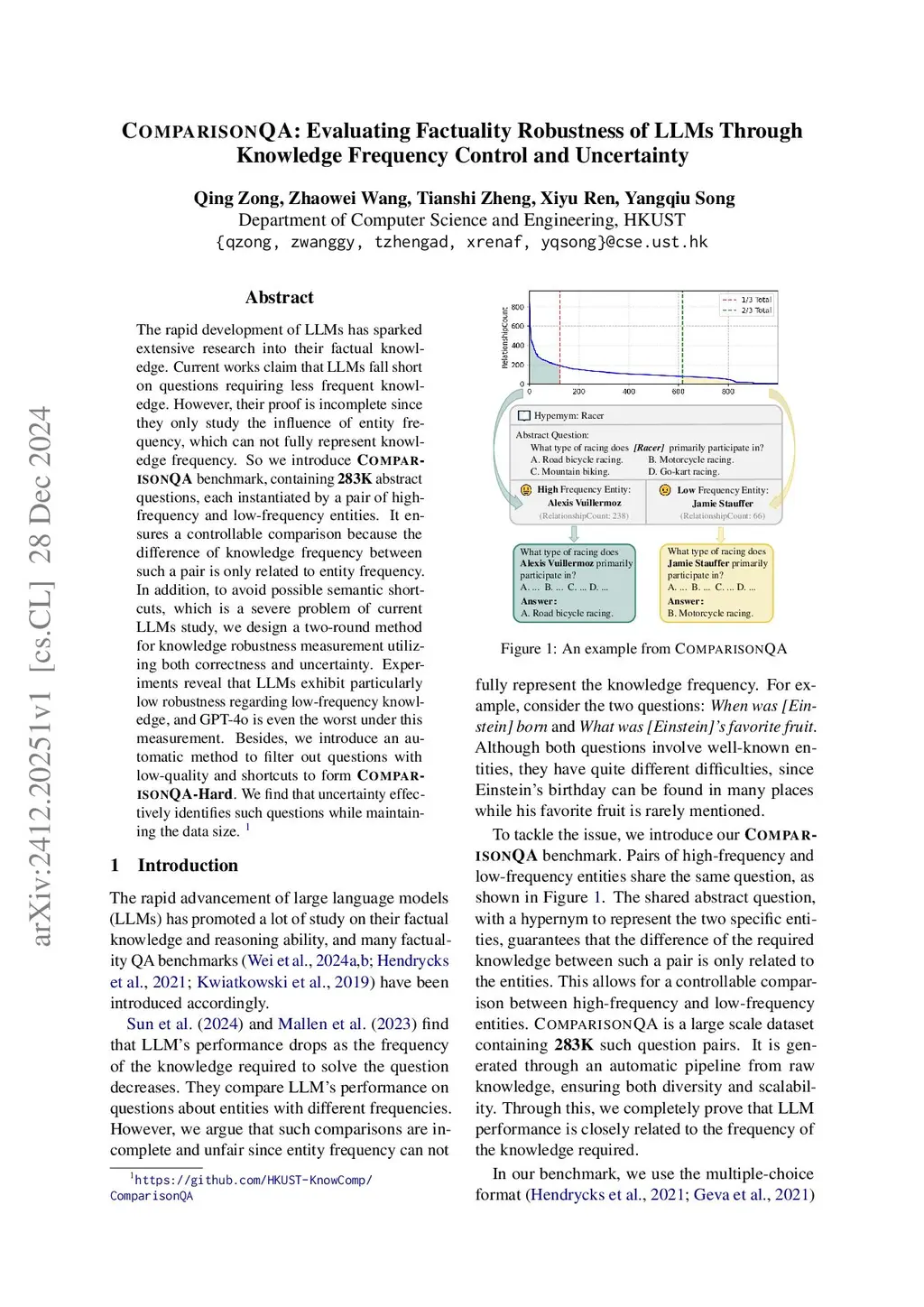
The rapid development of LLMs has sparked extensive research into their factual knowledge. Current works find that LLMs fall short on questions around low-frequency entities. However, such proofs are unreliable since the questions can differ not only in entity frequency but also in difficulty themselves. So we introduce ComparisonQA benchmark, containing 283K abstract questions, each instantiated by a pair of high-frequency and low-frequency entities. It ensures a controllable comparison to study the role of knowledge frequency in the performance of LLMs. Because the difference between such a pair is only the entity with different frequencies. In addition, we use both correctness and uncertainty to develop a two-round method to evaluate LLMs' knowledge robustness. It aims to avoid possible semantic shortcuts which is a serious problem of current QA study. Experiments reveal that LLMs, including GPT-4o, exhibit particularly low robustness regarding low-frequency knowledge. Besides, we find that uncertainty can be used to effectively identify high-quality and shortcut-free questions while maintaining the data size. Based on this, we propose an automatic method to select such questions to form a subset called ComparisonQA-Hard, containing only hard low-frequency questions.
View on arXiv