
Refinement Module based on Parse Graph of Feature Map for Human Pose
Estimation
- 3DH
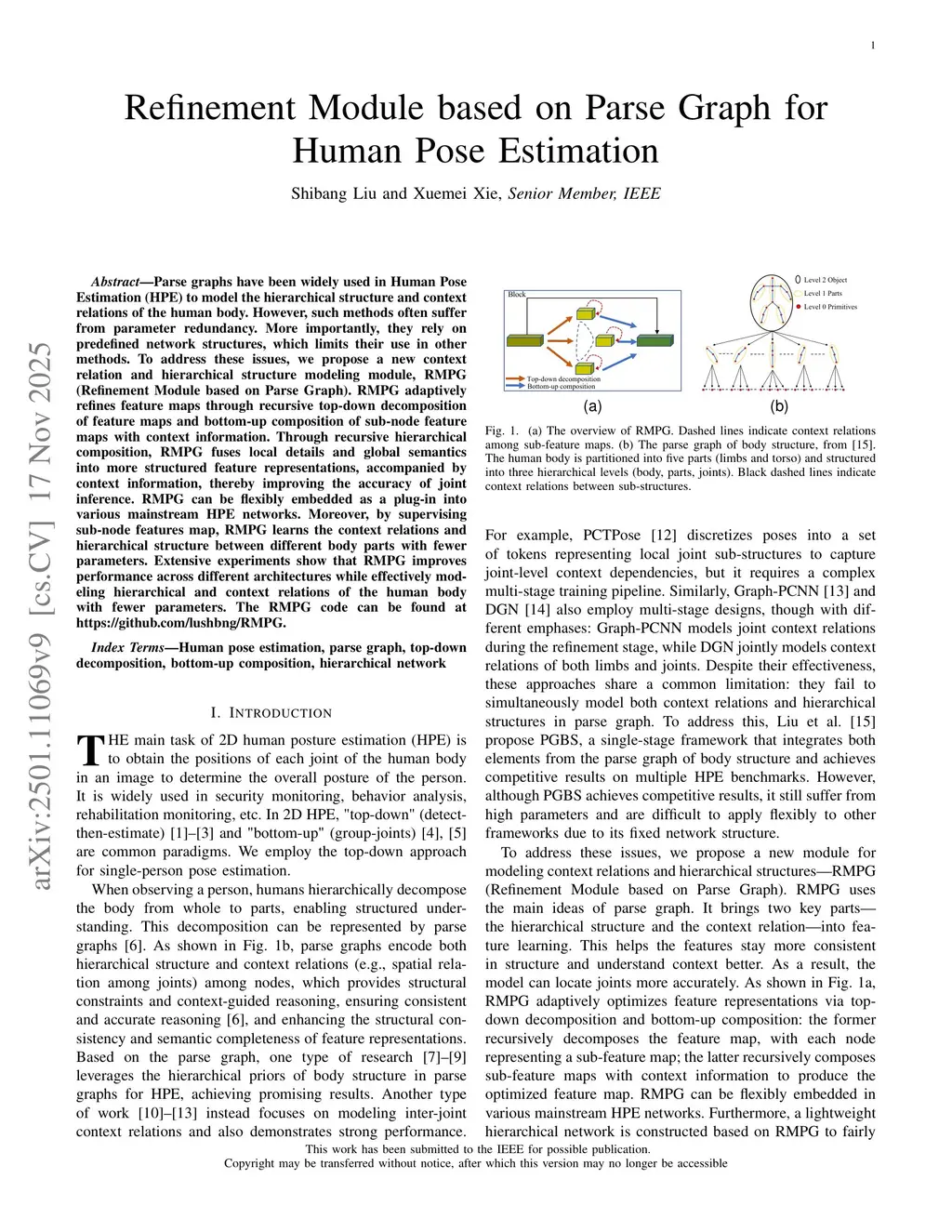
Parse graphs of the human body can be obtained in the human brain to help humans complete the human pose estimation (HPE). It contains a hierarchical structure, like a tree structure, and context relations among nodes. Many researchers predefine the parse graph of body structure to design HPE frameworks. However, these frameworks struggle to adapt to instances that deviate from the predefined parse graph and are often parameter-heavy. Unlike them, we view the feature map holistically, much like the human body. It can be optimized using parse graphs, where each node's feature is an implicit expression rather than a fixed one. This allows it to adapt to more instances, unconstrained by rigid structural features. In this paper, we design the Refinement Module based on the Parse Graph of feature map (RMPG), which includes two stages: top-down decomposition and bottom-up combination. In the first stage, the feature map is decomposed into multiple sub-feature maps along the channel. In the second stage, the context relations of sub-feature maps are calculated to obtain their respective context information and the sub-feature maps with context information are concatenated along channels to obtain the refined feature map. Additionally, we design a hierarchical network with fewer parameters using multiple RMPG modules for HPE according to the parse graph of body structure, some of which are supervised to obtain context relations among body parts. Our network achieves excellent results on multiple mainstream human pose datasets. More importantly, the effectiveness of RMPG is proven on different methods. The code of RMPG will be open.
View on arXiv