
Optimizing Pretraining Data Mixtures with LLM-Estimated Utility
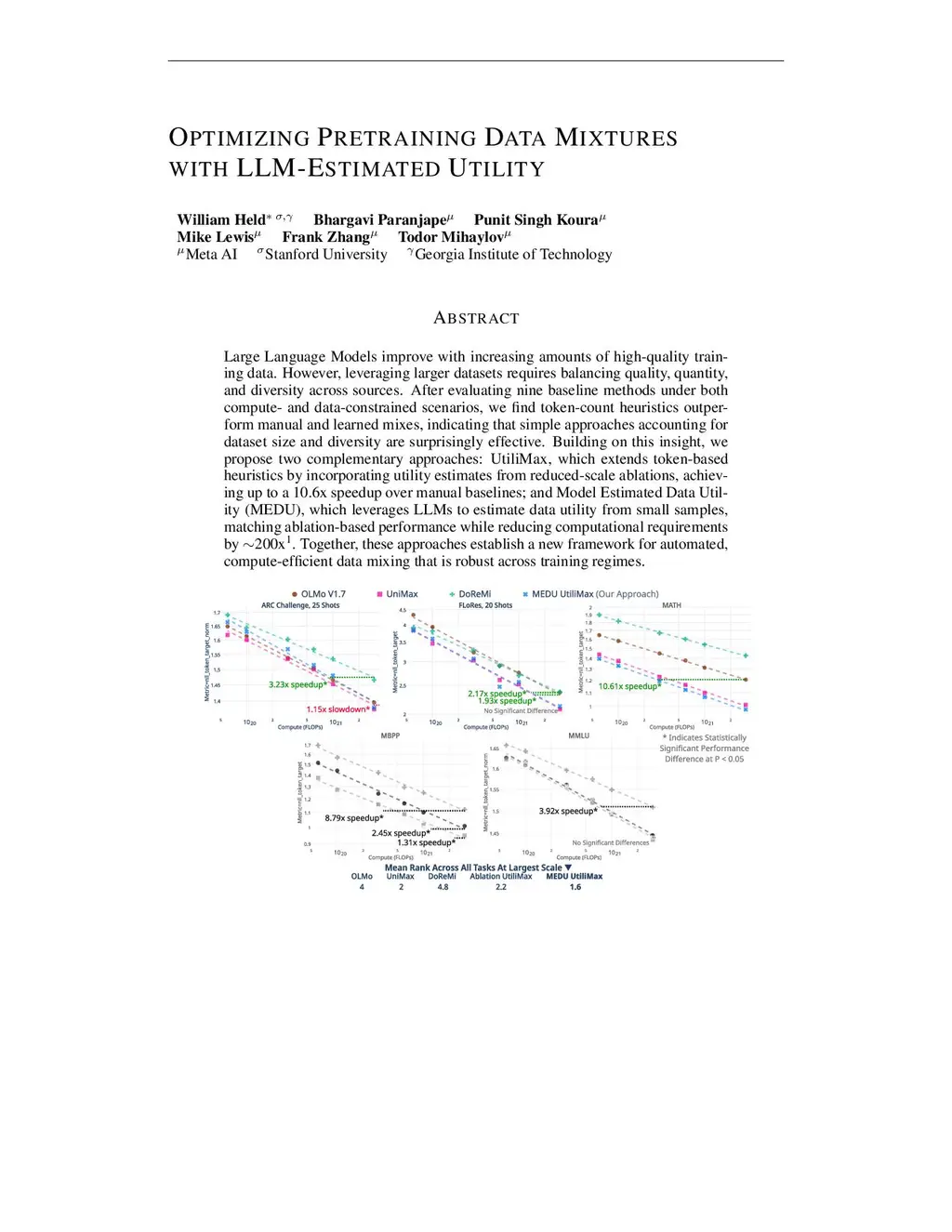
Large Language Models improve with increasing amounts of high-quality training data. However, leveraging larger datasets requires balancing quality, quantity, and diversity across sources. After evaluating nine baseline methods under both compute- and data-constrained scenarios, we find token-count heuristics outperform manual and learned mixes, indicating that simple approaches accounting for dataset size and diversity are surprisingly effective. Building on this insight, we propose two complementary approaches: UtiliMax, which extends token-based heuristics by incorporating utility estimates from reduced-scale ablations, achieving up to a 10.6x speedup over manual baselines; and Model Estimated Data Utility (MEDU), which leverages LLMs to estimate data utility from small samples, matching ablation-based performance while reducing computational requirements by 200x. Together, these approaches establish a new framework for automated, compute-efficient data mixing that is robust across training regimes.
View on arXiv