
Option-ID Based Elimination For Multiple Choice Questions
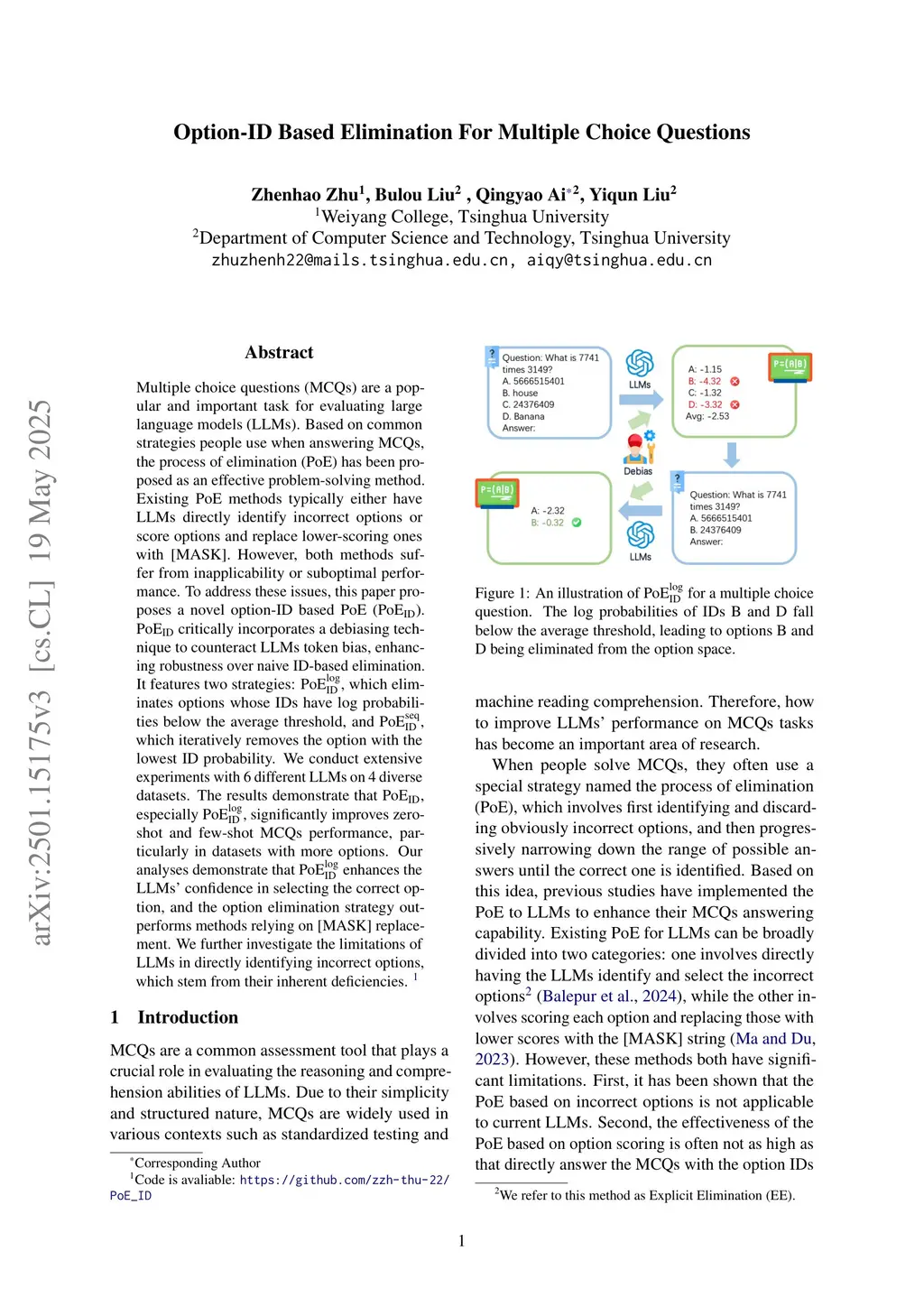
Multiple choice questions (MCQs) are a popular and important task for evaluating large language models (LLMs). Based on common strategies people use when answering MCQs, the process of elimination (PoE) has been proposed as an effective problem-solving method. Existing PoE methods typically either have LLMs directly identify incorrect options or score options and replace lower-scoring ones with [MASK]. However, both methods suffer from inapplicability or suboptimal performance. To address these issues, this paper proposes a novel option-ID based PoE (). critically incorporates a debiasing technique to counteract LLMs token bias, enhancing robustness over naive ID-based elimination. It features two strategies: , which eliminates options whose IDs have log probabilities below the average threshold, and , which iteratively removes the option with the lowest ID probability. We conduct extensive experiments with 6 different LLMs on 4 diverse datasets. The results demonstrate that , especially , significantly improves zero-shot and few-shot MCQs performance, particularly in datasets with more options. Our analyses demonstrate that enhances the LLMs' confidence in selecting the correct option, and the option elimination strategy outperforms methods relying on [MASK] replacement. We further investigate the limitations of LLMs in directly identifying incorrect options, which stem from their inherent deficiencies.
View on arXiv