
Achieving Hyperbolic-Like Expressiveness with Arbitrary Euclidean Regions: A New Approach to Hierarchical Embeddings
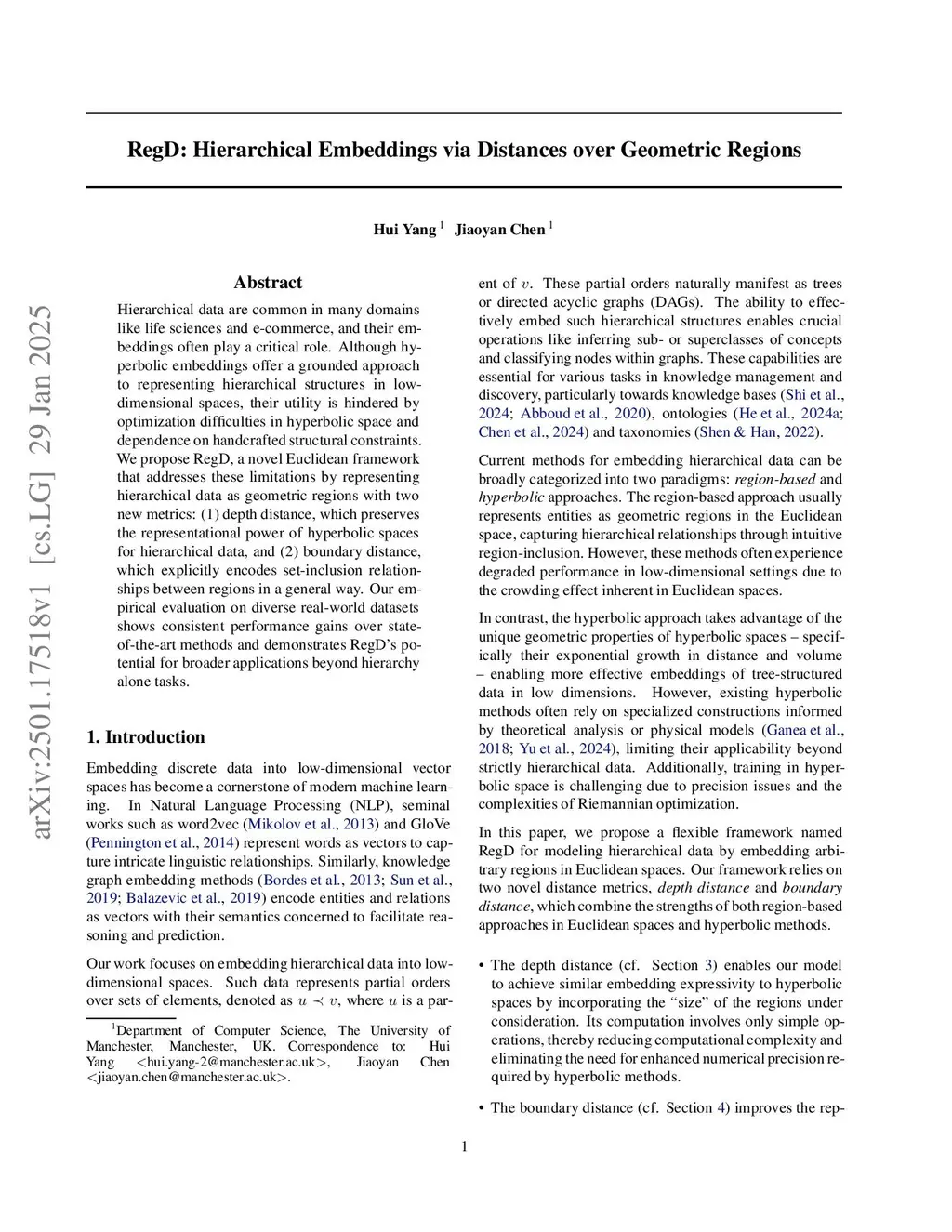
Hierarchical data is common in many domains like life sciences and e-commerce, and its embeddings often play a critical role. While hyperbolic embeddings offer a theoretically grounded approach to representing hierarchies in low-dimensional spaces, current methods often rely on specific geometric constructs as embedding candidates. This reliance limits their generalizability and makes it difficult to integrate with techniques that model semantic relationships beyond pure hierarchies, such as ontology embeddings. In this paper, we present RegD, a flexible Euclidean framework that supports the use of arbitrary geometric regions -- such as boxes and balls -- as embedding representations. Although RegD operates entirely in Euclidean space, we formally prove that it achieves hyperbolic-like expressiveness by incorporating a depth-based dissimilarity between regions, enabling it to emulate key properties of hyperbolic geometry, including exponential growth. Our empirical evaluation on diverse real-world datasets shows consistent performance gains over state-of-the-art methods and demonstrates RegD's potential for broader applications such as the ontology embedding task that goes beyond hierarchy.
View on arXiv