
Jingfang: An LLM-Based Multi-Agent System for Precise Medical Consultation and Syndrome Differentiation in Traditional Chinese Medicine
- LM&MAAI4CE
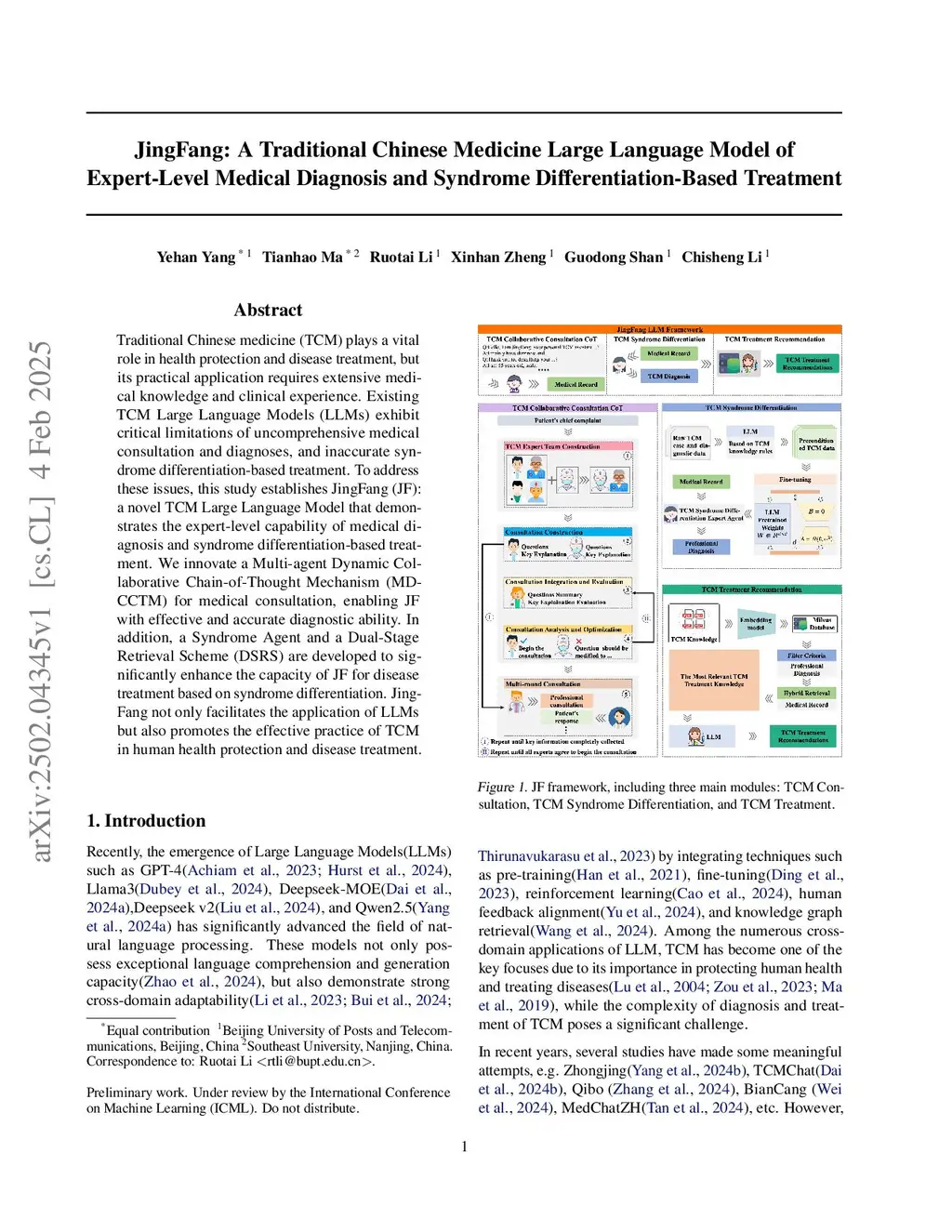
The practice of Traditional Chinese Medicine (TCM) requires profound expertise and extensive clinical experience. While Large Language Models (LLMs) offer significant potential in this domain, current TCM-oriented LLMs suffer two critical limitations: (1) a rigid consultation framework that fails to conduct comprehensive and patient-tailored interactions, often resulting in diagnostic inaccuracies; and (2) treatment recommendations generated without rigorous syndrome differentiation, which deviates from the core diagnostic and therapeutic principles of TCM. To address these issues, we develop \textbf{JingFang (JF)}, an advanced LLM-based multi-agent system for TCM that facilitates the implementation of AI-assisted TCM diagnosis and treatment. JF integrates various TCM Specialist Agents in accordance with authentic diagnostic and therapeutic scenarios of TCM, enabling personalized medical consultations, accurate syndrome differentiation and treatment recommendations. A \textbf{Multi-Agent Collaborative Consultation Mechanism (MACCM)} for TCM is constructed, where multiple Agents collaborate to emulate real-world TCM diagnostic workflows, enhancing the diagnostic ability of base LLMs to provide accurate and patient-tailored medical consultation. Moreover, we introduce a dedicated \textbf{Syndrome Differentiation Agent} fine-tuned on a preprocessed dataset, along with a designed \textbf{Dual-Stage Recovery Scheme (DSRS)} within the Treatment Agent, which together substantially improve the model's accuracy of syndrome differentiation and treatment. Comprehensive evaluations and experiments demonstrate JF's superior performance in medical consultation, and also show improvements of at least 124% and 21.1% in the precision of syndrome differentiation compared to existing TCM models and State of the Art (SOTA) LLMs, respectively.
View on arXiv