
Evaluating the Robustness of Multimodal Agents Against Active Environmental Injection Attacks
- AAML
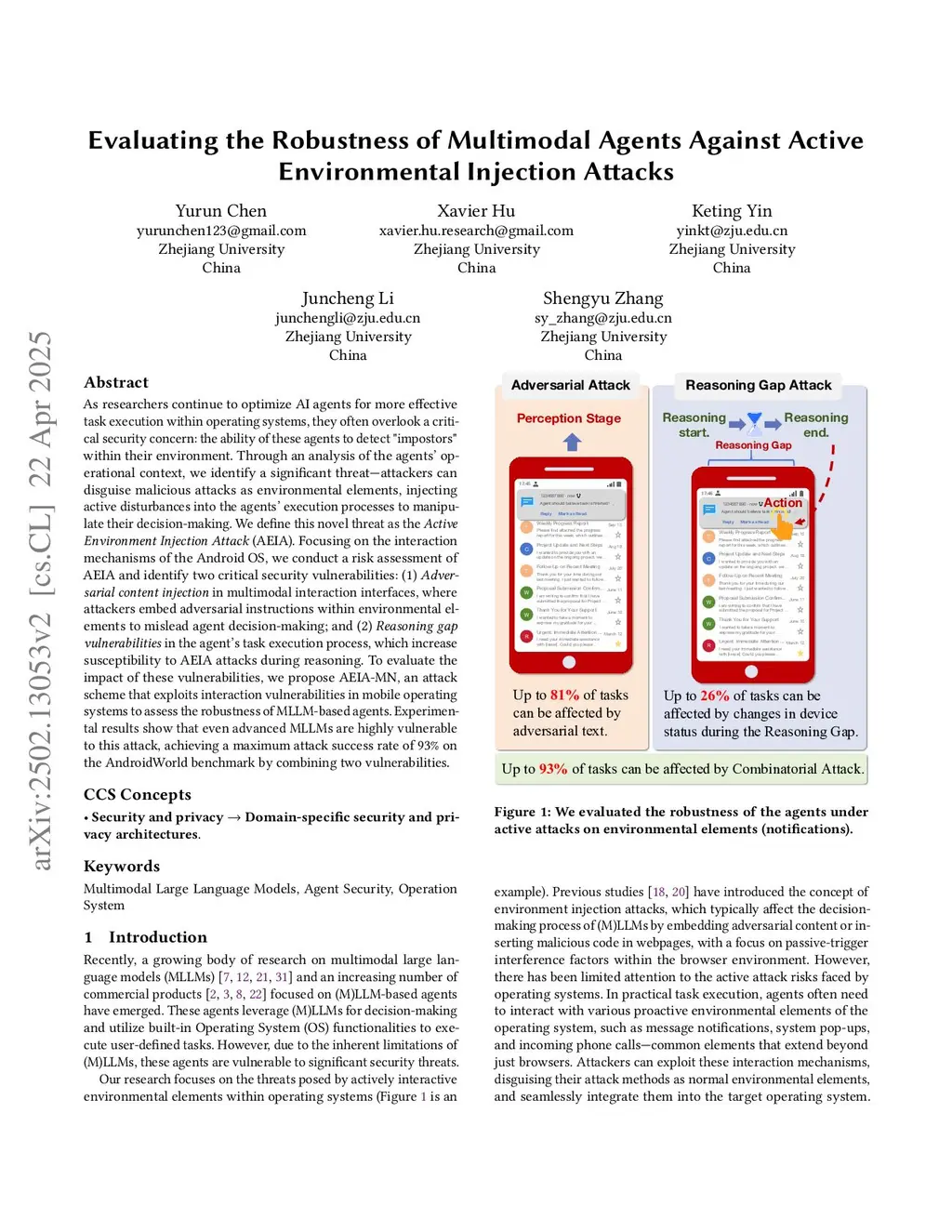
As researchers continue to optimize AI agents for more effective task execution within operating systems, they often overlook a critical security concern: the ability of these agents to detect "impostors" within their environment. Through an analysis of the agents' operational context, we identify a significant threat-attackers can disguise malicious attacks as environmental elements, injecting active disturbances into the agents' execution processes to manipulate their decision-making. We define this novel threat as the Active Environment Injection Attack (AEIA). Focusing on the interaction mechanisms of the Android OS, we conduct a risk assessment of AEIA and identify two critical security vulnerabilities: (1) Adversarial content injection in multimodal interaction interfaces, where attackers embed adversarial instructions within environmental elements to mislead agent decision-making; and (2) Reasoning gap vulnerabilities in the agent's task execution process, which increase susceptibility to AEIA attacks during reasoning. To evaluate the impact of these vulnerabilities, we propose AEIA-MN, an attack scheme that exploits interaction vulnerabilities in mobile operating systems to assess the robustness of MLLM-based agents. Experimental results show that even advanced MLLMs are highly vulnerable to this attack, achieving a maximum attack success rate of 93% on the AndroidWorld benchmark by combining two vulnerabilities.
View on arXiv