
Analysis of Efficiency of the Messaging Layer Security protocol in Experimental Settings
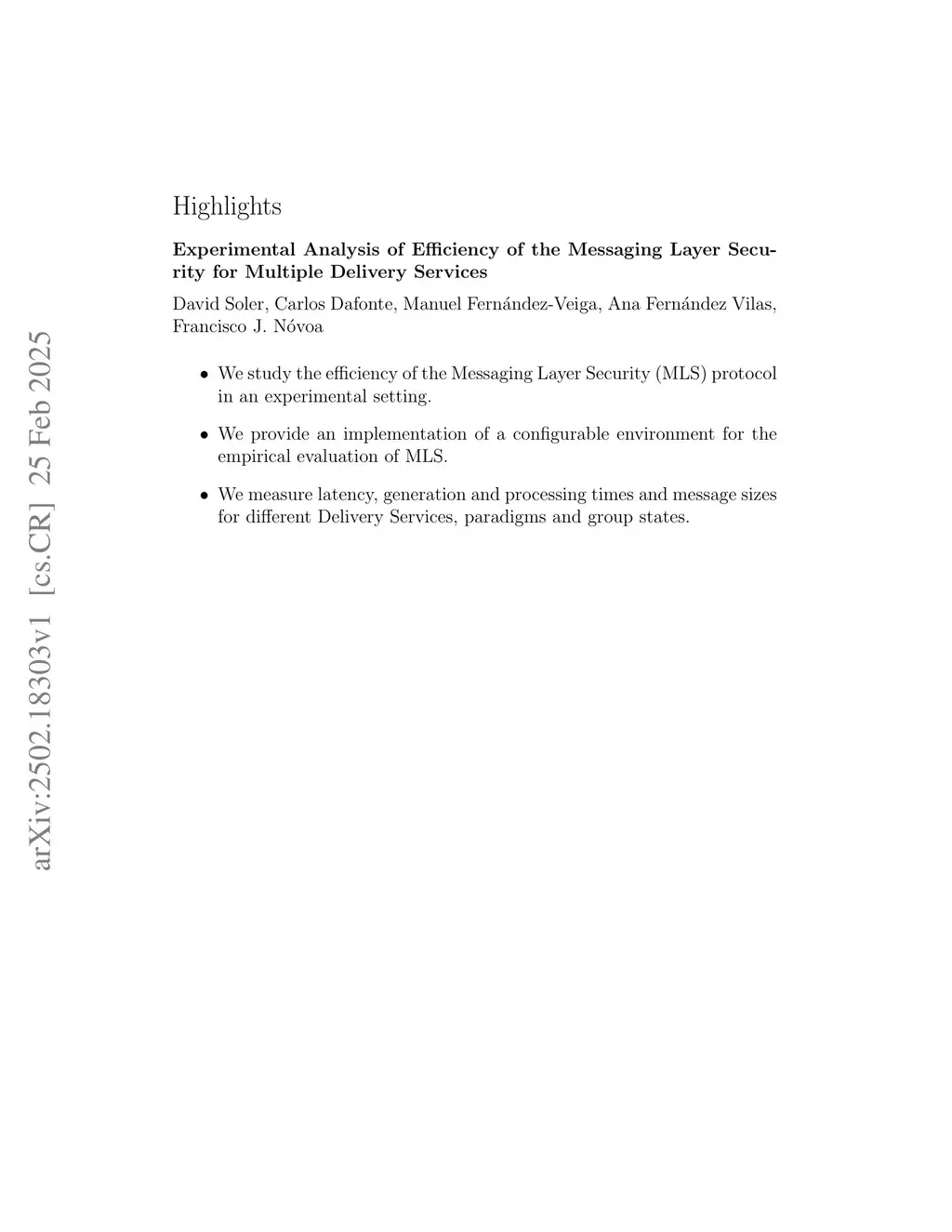
Messaging Layer Security (MLS) and its underlying Continuous Group Key Agreement (CGKA) protocol allows a group of users to share a cryptographic secret in a dynamic manner, such that the secret is modified in member insertions and deletions. One of the most relevant contributions of MLS is its efficiency, as its communication cost scales logarithmically with the number of members. However, this claim has only been analysed in theoretical models and thus it is unclear how efficient MLS is in real-world scenarios. Furthermore, practical considerations such as the chosen paradigm and the evolution of the group can also influence the performance of an MLS group. In this work we analyse MLS from an empirical viewpoint: we provide real-world measurements for metrics such as commit generation and processing times and message sizes under different conditions. In order to obtain these results we have developed a highly configurable environment for empirical evaluations of MLS through the emulation of MLS clients. Among other findings, our results show that computation costs scale linearly in practical settings even in the best-case scenario.
View on arXiv