
Spatial-RAG: Spatial Retrieval Augmented Generation for Real-World Geospatial Reasoning Questions
- ReLMLRM
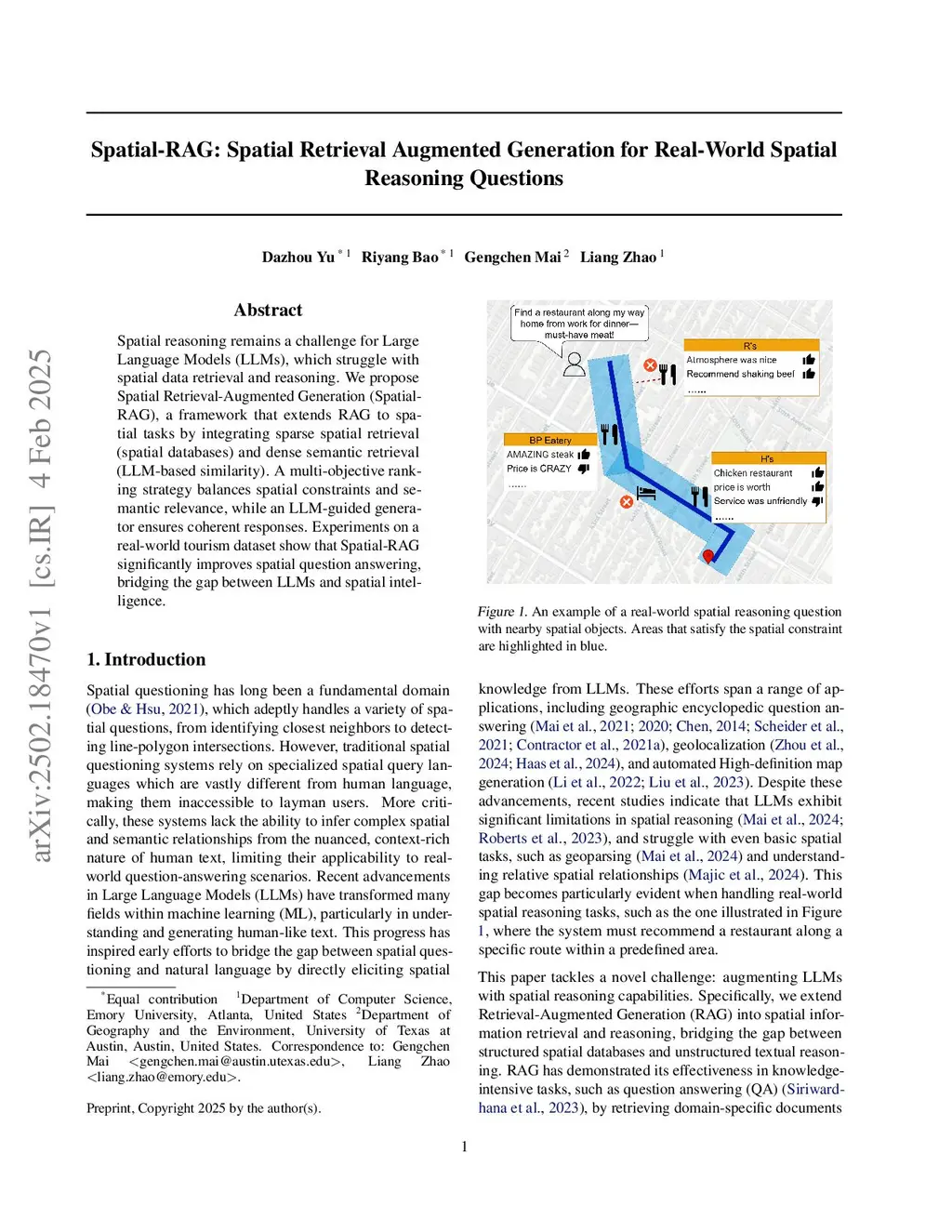
Answering real-world geospatial questions--such as finding restaurants along a travel route or amenities near a landmark--requires reasoning over both geographic relationships and semantic user intent. However, existing large language models (LLMs) lack spatial computing capabilities and access to up-to-date, ubiquitous real-world geospatial data, while traditional geospatial systems fall short in interpreting natural language. To bridge this gap, we introduce Spatial-RAG, a Retrieval-Augmented Generation (RAG) framework designed for geospatial question answering. Spatial-RAG integrates structured spatial databases with LLMs via a hybrid spatial retriever that combines sparse spatial filtering and dense semantic matching. It formulates the answering process as a multi-objective optimization over spatial and semantic relevance, identifying Pareto-optimal candidates and dynamically selecting the best response based on user intent. Experiments across multiple tourism and map-based QA datasets show that Spatial-RAG significantly improves accuracy, precision, and ranking performance over strong baselines.
View on arXiv