
MAFE: Enabling Equitable Algorithm Design in Multi-Agent Multi-Stage Decision-Making Systems
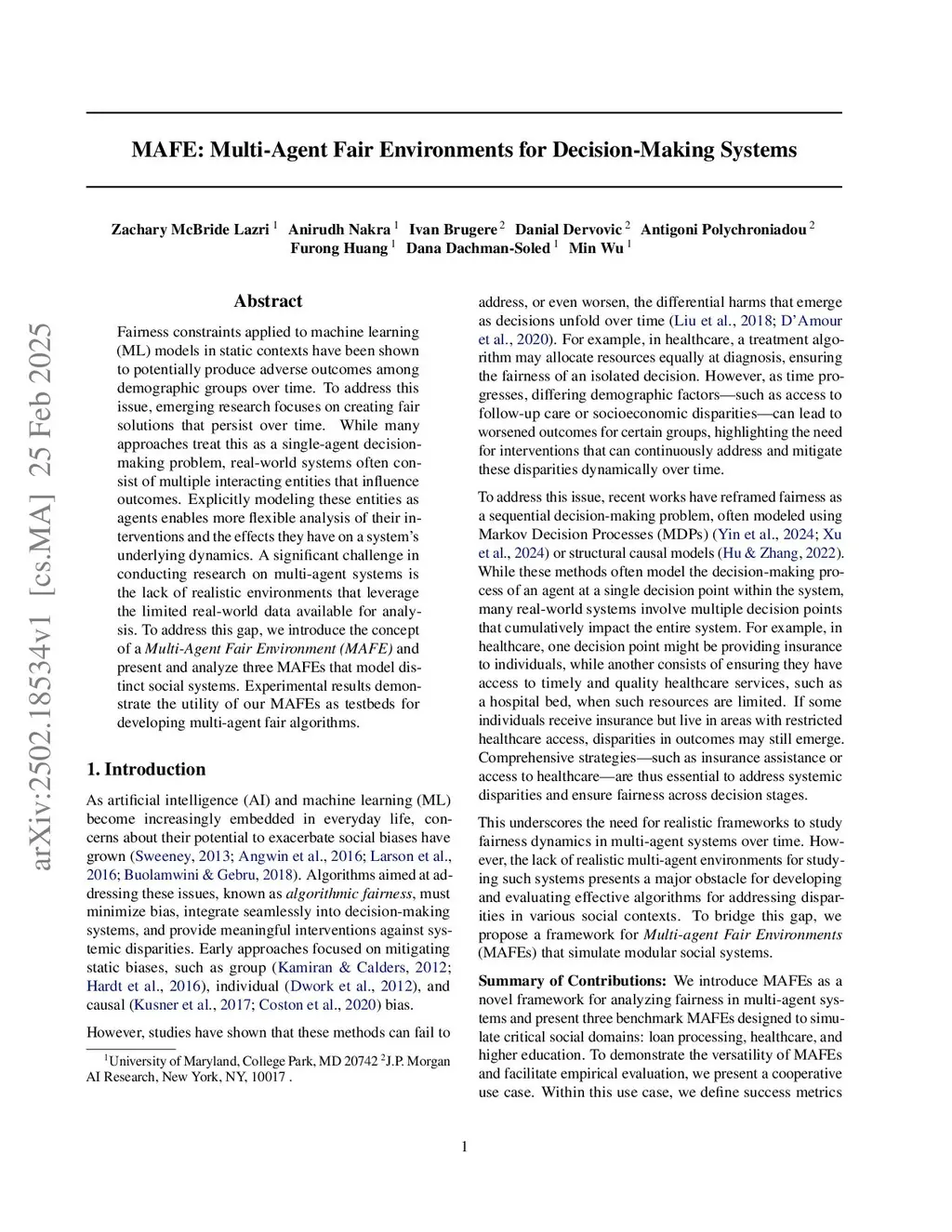
Algorithmic fairness is often studied in static or single-agent settings, yet many real-world decision-making systems involve multiple interacting entities whose multi-stage actions jointly influence long-term outcomes. Existing fairness methods applied at isolated decision points frequently fail to mitigate disparities that accumulate over time. Although recent work has modeled fairness as a sequential decision-making problem, it typically assumes centralized agents or simplified dynamics, limiting its applicability to complex social systems. We introduce MAFE, a suite of Multi-Agent Fair Environments designed to simulate realistic, modular, and dynamic systems in which fairness emerges from the interplay of multiple agents. We demonstrate MAFEs across three domains -- loan processing, healthcare, and higher education -- that support heterogeneous agents, configurable interventions, and fairness metrics. The environments are open-source and compatible with standard multi-agent reinforcement learning (MARL) libraries, enabling reproducible evaluation of fairness-aware policies. Through extensive experiments on cooperative use cases, we demonstrate how MAFE facilitates the design of equitable multi-agent algorithms and reveals critical trade-offs between fairness, performance, and coordination. MAFE provides a foundation for systematic progress in dynamic, multi-agent fairness research.
View on arXiv