
Do Vision Encoders Truly Explain Object Hallucination?: Mitigating Object Hallucination via Simple Fine-Grained CLIPScore
- VLM
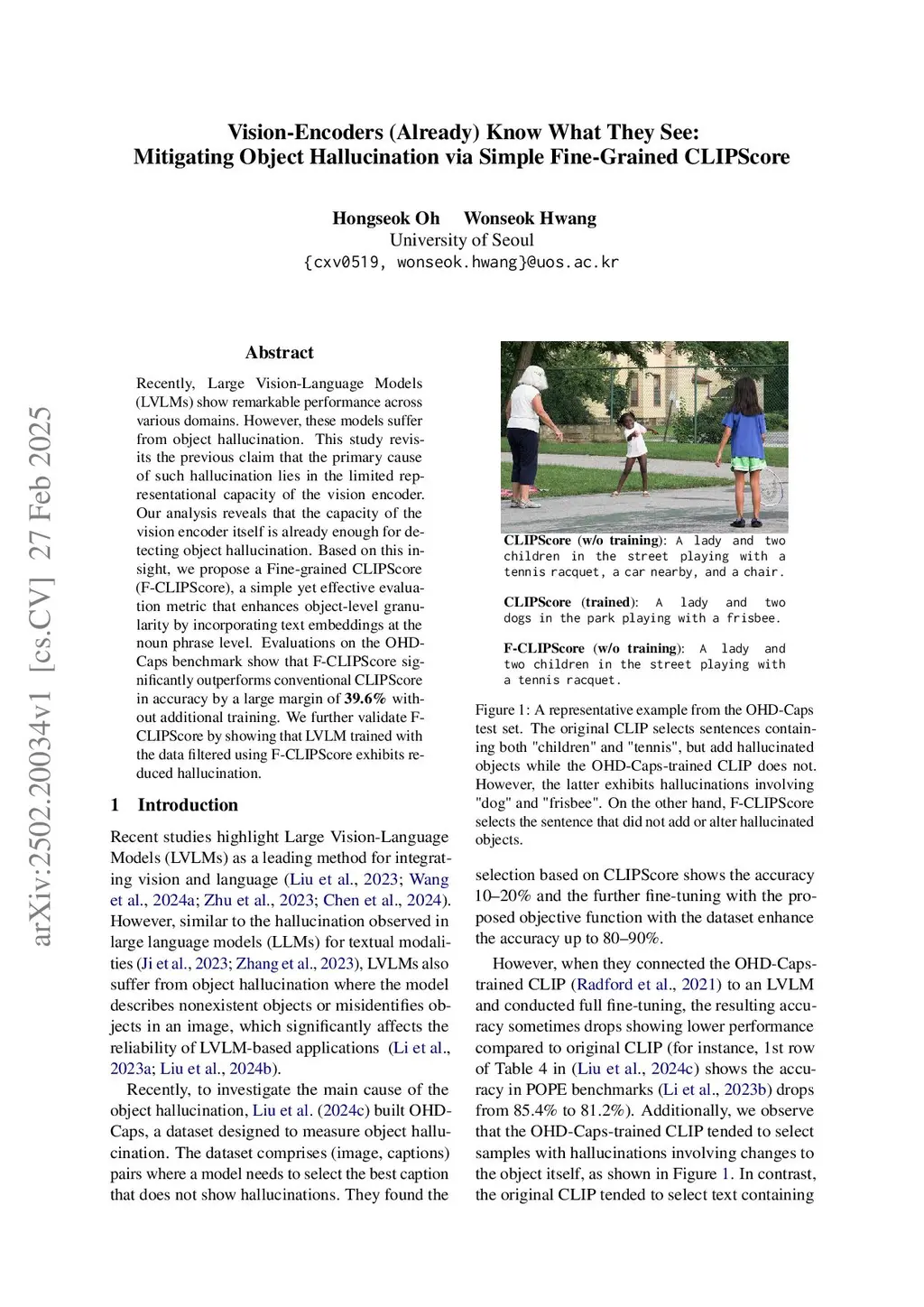
Recently, Large Vision-Language Models (LVLMs) show remarkable performance across various domains. However, these models suffer from object hallucination. This study revisits the previous claim that the cause of such hallucinations lies in the limited representational capacity of the vision encoder. Our analysis implies that the capacity of the vision encoder is not necessarily a major limiting factor in detecting object hallucination. Based on this insight, we propose Fine-grained CLIPScore (F-CLIPScore), a simple yet effective evaluation metric that enhances object-level granularity by incorporating text embeddings at the noun level. Evaluations on the OHD-Caps benchmark show that F-CLIPScore significantly outperforms conventional CLIPScore in accuracy by a large margin of \textbf{39.6\%} without additional training. We further demonstrate that F-CLIPScore-based data filtering reduces object hallucination in LVLM (4.9\% in POPE).
View on arXiv