
Retinex-MEF: Retinex-based Glare Effects Aware Unsupervised Multi-Exposure Image Fusion
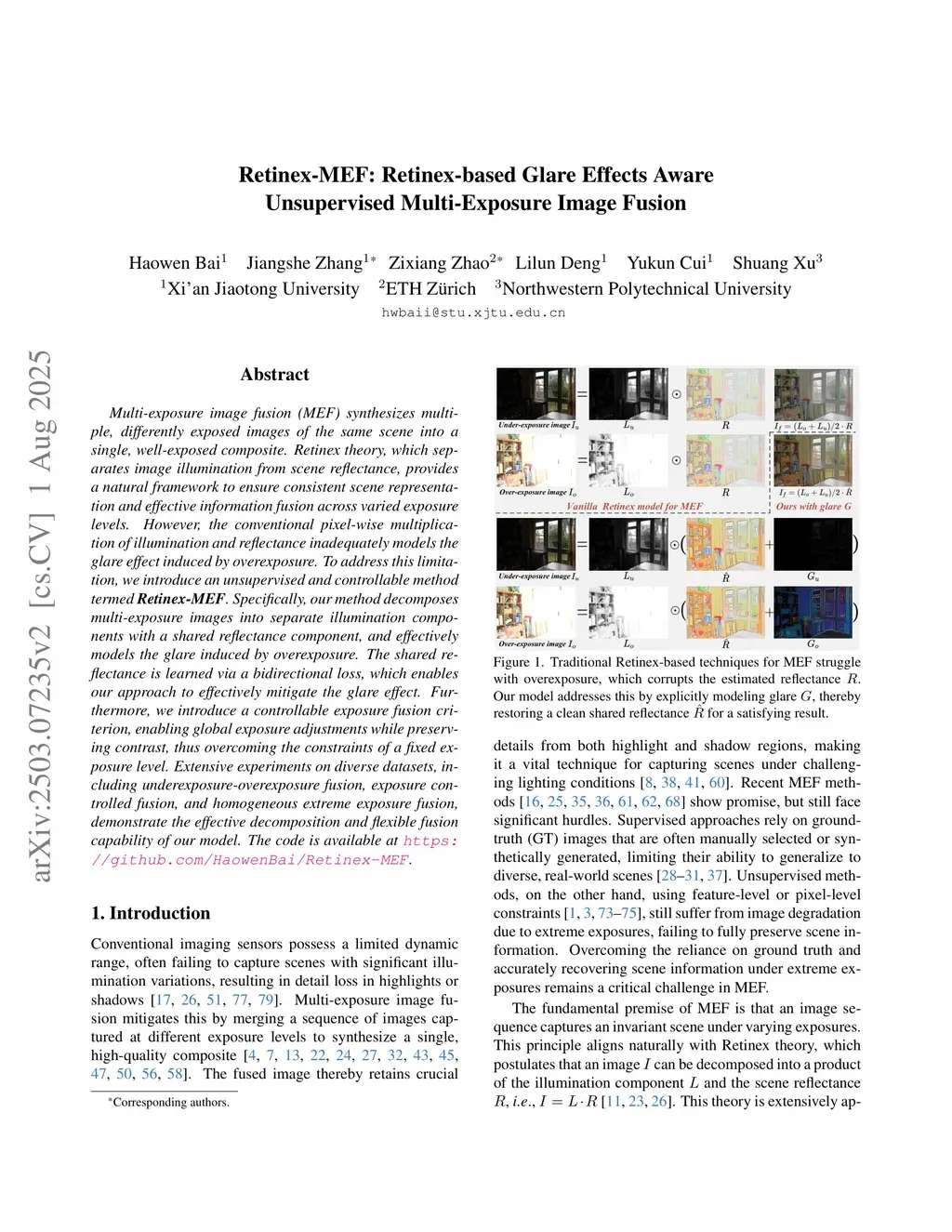
Multi-exposure image fusion (MEF) synthesizes multiple, differently exposed images of the same scene into a single, well-exposed composite. Retinex theory, which separates image illumination from scene reflectance, provides a natural framework to ensure consistent scene representation and effective information fusion across varied exposure levels. However, the conventional pixel-wise multiplication of illumination and reflectance inadequately models the glare effect induced by overexposure. To address this limitation, we introduce an unsupervised and controllable method termed Retinex-MEF. Specifically, our method decomposes multi-exposure images into separate illumination components with a shared reflectance component, and effectively models the glare induced by overexposure. The shared reflectance is learned via a bidirectional loss, which enables our approach to effectively mitigate the glare effect. Furthermore, we introduce a controllable exposure fusion criterion, enabling global exposure adjustments while preserving contrast, thus overcoming the constraints of a fixed exposure level. Extensive experiments on diverse datasets, including underexposure-overexposure fusion, exposure controlled fusion, and homogeneous extreme exposure fusion, demonstrate the effective decomposition and flexible fusion capability of our model. The code is available atthis https URL
View on arXiv