
Reassessing Active Learning Adoption in Contemporary NLP: A Community Survey
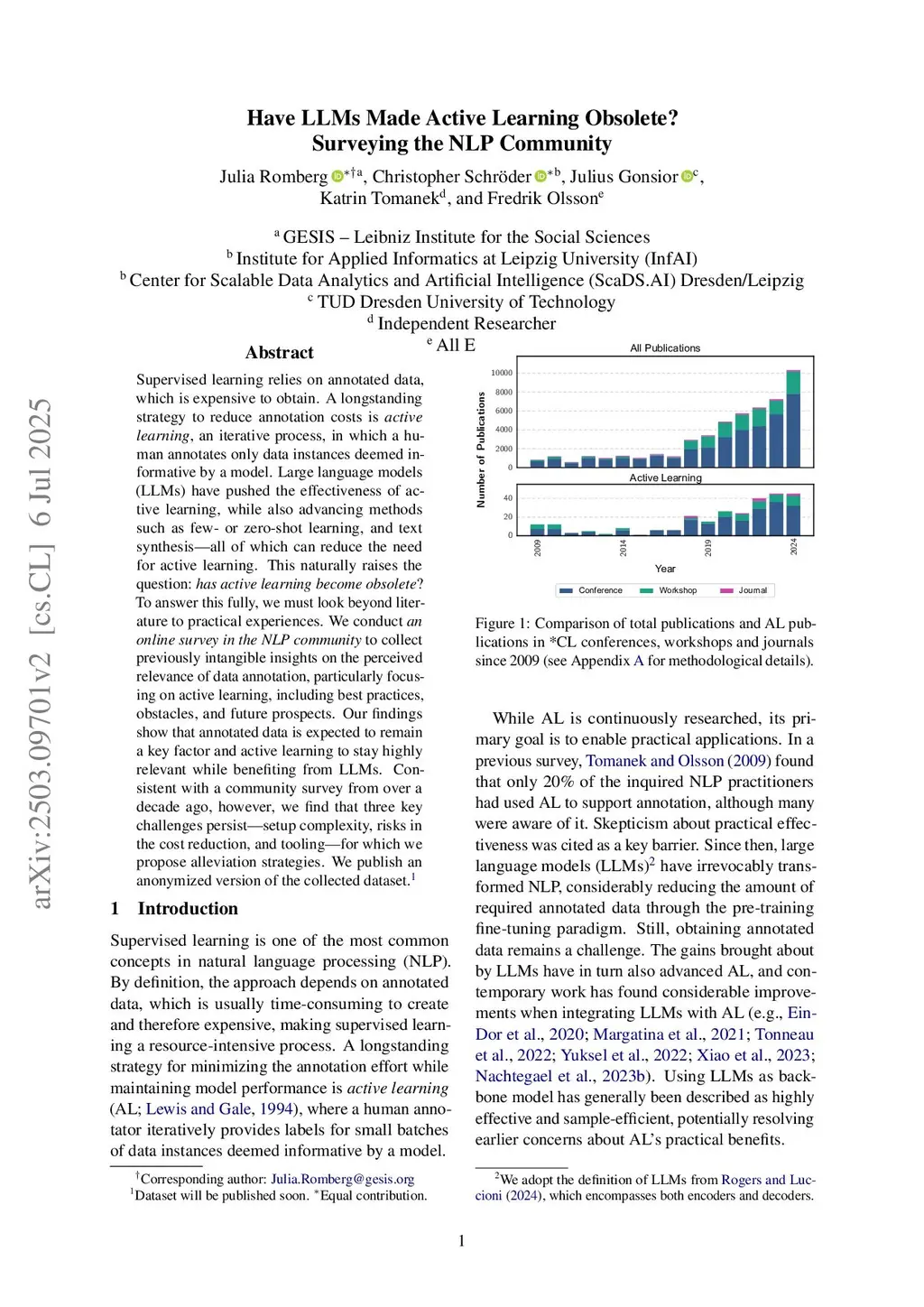
Supervised learning relies on data annotation which usually is time-consuming and therefore expensive. A longstanding strategy to reduce annotation costs is active learning, an iterative process, in which a human annotates only data instances deemed informative by a model. Research in active learning has made considerable progress, especially with the rise of large language models (LLMs). However, we still know little about how these remarkable advances have translated into real-world applications, or contributed to removing key barriers to active learning adoption. To fill in this gap, we conduct an online survey in the NLP community to collect previously intangible insights on current implementation practices, common obstacles in application, and future prospects in active learning. We also reassess the perceived relevance of data annotation and active learning as fundamental assumptions. Our findings show that data annotation is expected to remain important and active learning to stay relevant while benefiting from LLMs. Consistent with a community survey from over 15 years ago, three key challenges yet persist -- setup complexity, uncertain cost reduction, and tooling -- for which we propose alleviation strategies. We publish an anonymized version of the dataset.
View on arXiv