
SPOC: Spatially-Progressing Object State Change Segmentation in Video
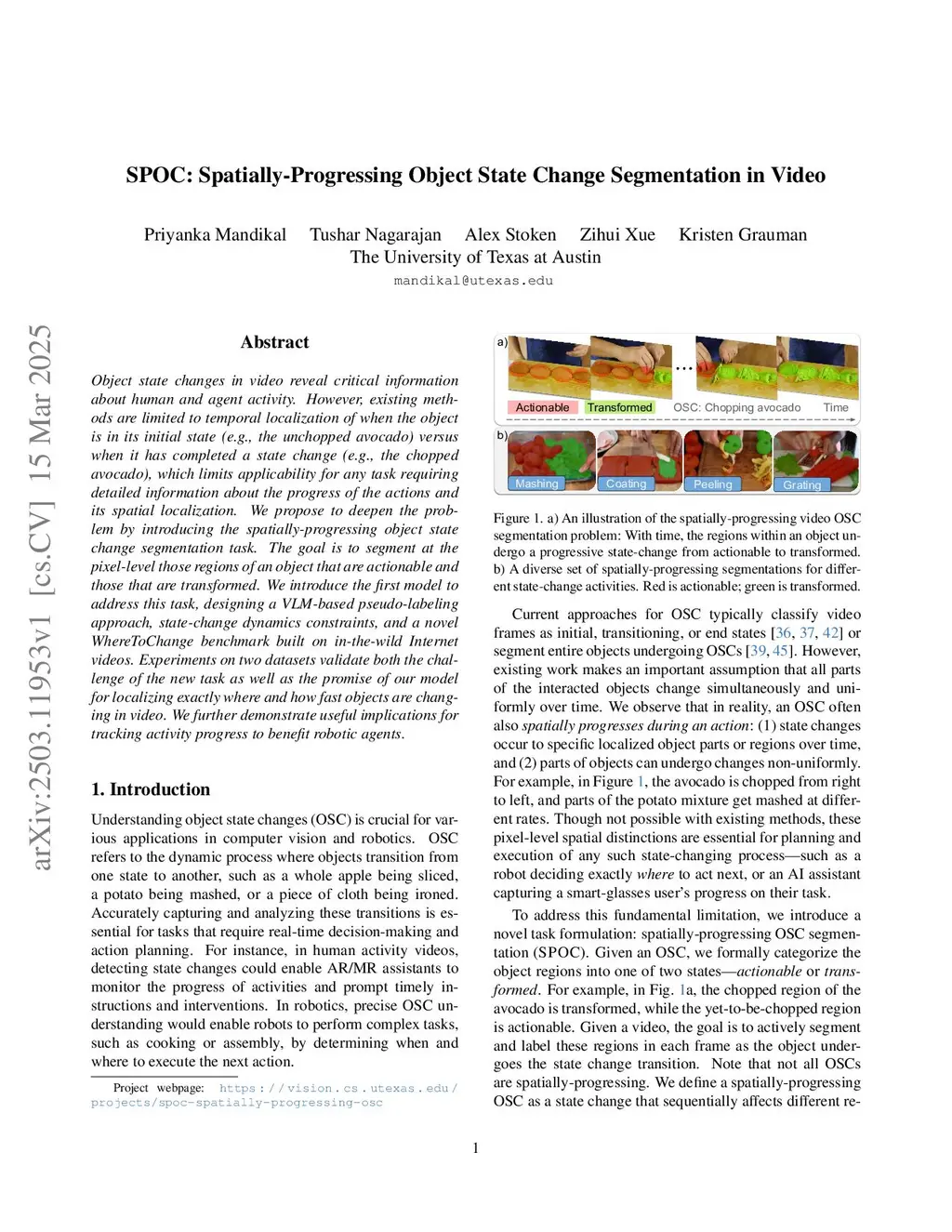
Object state changes in video reveal critical cues about human and agent activity. However, existing methods are limited to temporal localization of when the object is in its initial state (e.g., cheese block) versus when it has completed a state change (e.g., grated cheese), offering no insight into where the change is unfolding. We propose to deepen the problem by introducing the spatially-progressing object state change segmentation task. The goal is to segment at the pixel-level those regions of an object that are actionable and those that are transformed. We show that state-of-the-art VLMs and video segmentation methods struggle at this task, underscoring its difficulty and novelty. As an initial baseline, we design a VLM-based pseudo-labeling approach, state-change dynamics constraints, and a novel WhereToChange benchmark built on in-the-wild Internet videos. Experiments on two datasets validate both the challenge of the new task as well as the promise of our model for localizing exactly where and how fast objects are changing in video. We further demonstrate useful implications for tracking activity progress to benefit robotic agents. Overall, our work positions spatial OSC segmentation as a new frontier task for video understanding: one that challenges current SOTA methods and invites the community to build more robust, state-change-sensitive representations. Project page:this https URL
View on arXiv