
L2RW+: A Comprehensive Benchmark Towards Privacy-Preserved Visible-Infrared Person Re-Identification
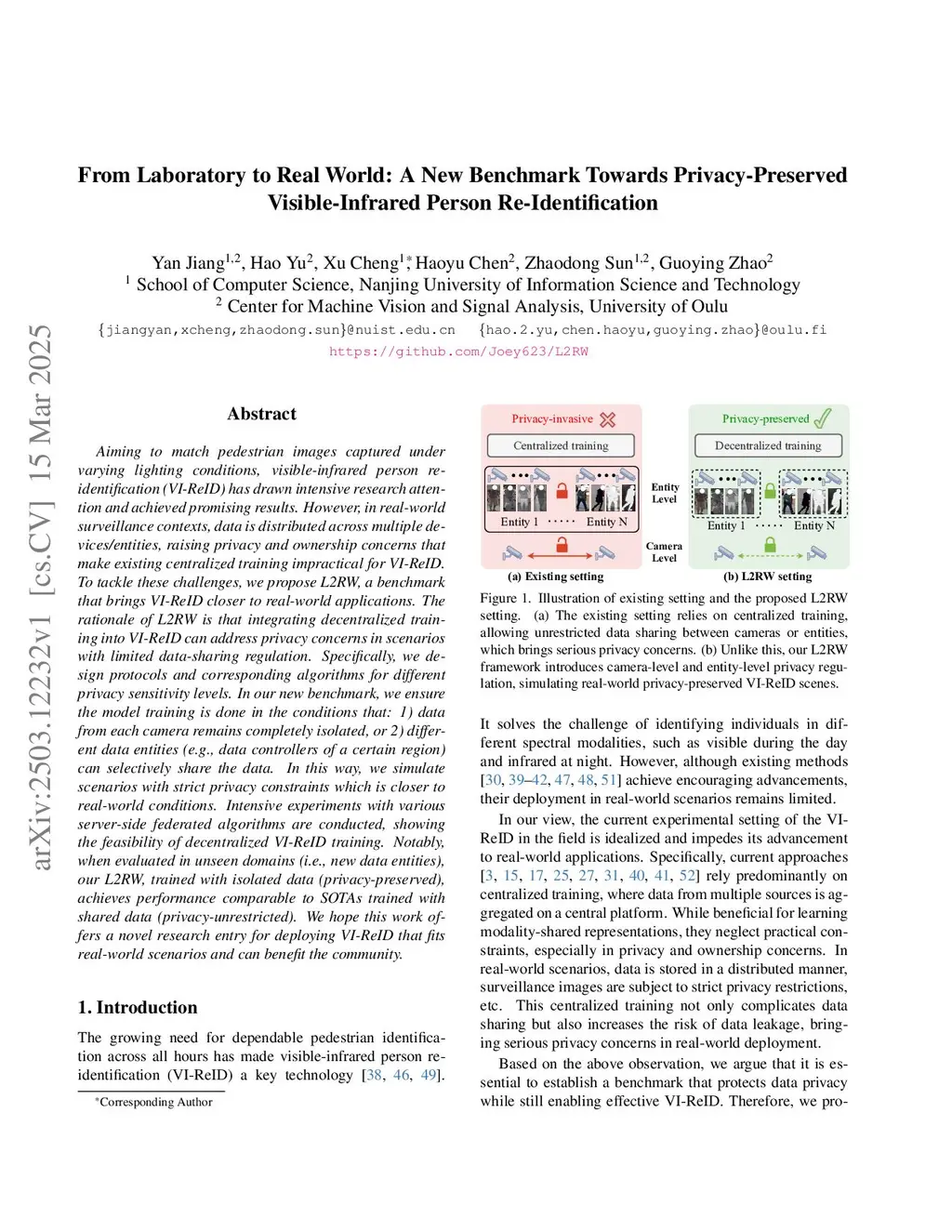
Visible-infrared person re-identification (VI-ReID) is a challenging task that aims to match pedestrian images captured under varying lighting conditions, which has drawn intensive research attention and achieved promising results. However, existing methods adopt the centralized training, ignoring the potential privacy concerns as the data is distributed across multiple devices or entities in reality. In this paper, we propose L2RW+, a benchmark that brings VI-ReID closer to real-world applications. The core rationale behind L2RW+ is that incorporating decentralized training into VI-ReID can address privacy concerns in scenarios with limited data-sharing constrains. Specifically, we design protocols and corresponding algorithms for different privacy sensitivity levels. In our new benchmark, we simulate the training under real-world data conditions that: 1) data from each camera is completely isolated, or 2) different data entities (e.g., data controllers of a certain region) can selectively share the data. In this way, we simulate scenarios with strict privacy restrictions, which is closer to real-world conditions. Comprehensive experiments show the feasibility and potential of decentralized VI-ReID training at both image and video levels. In particular, with increasing data scales, the performance gap between decentralized and centralized training decreases, especially in video-level VI-ReID. In unseen domains, decentralized training even achieves performance comparable to SOTA centralized methods. This work offers a novel research entry for deploying VI-ReID into real-world scenarios and can benefit the community. Code is available at:this https URL.
View on arXiv