
Dynamic-Dark SLAM: RGB-Thermal Cooperative Robot Vision Strategy for Multi-Person Tracking in Both Well-Lit and Low-Light Scenes
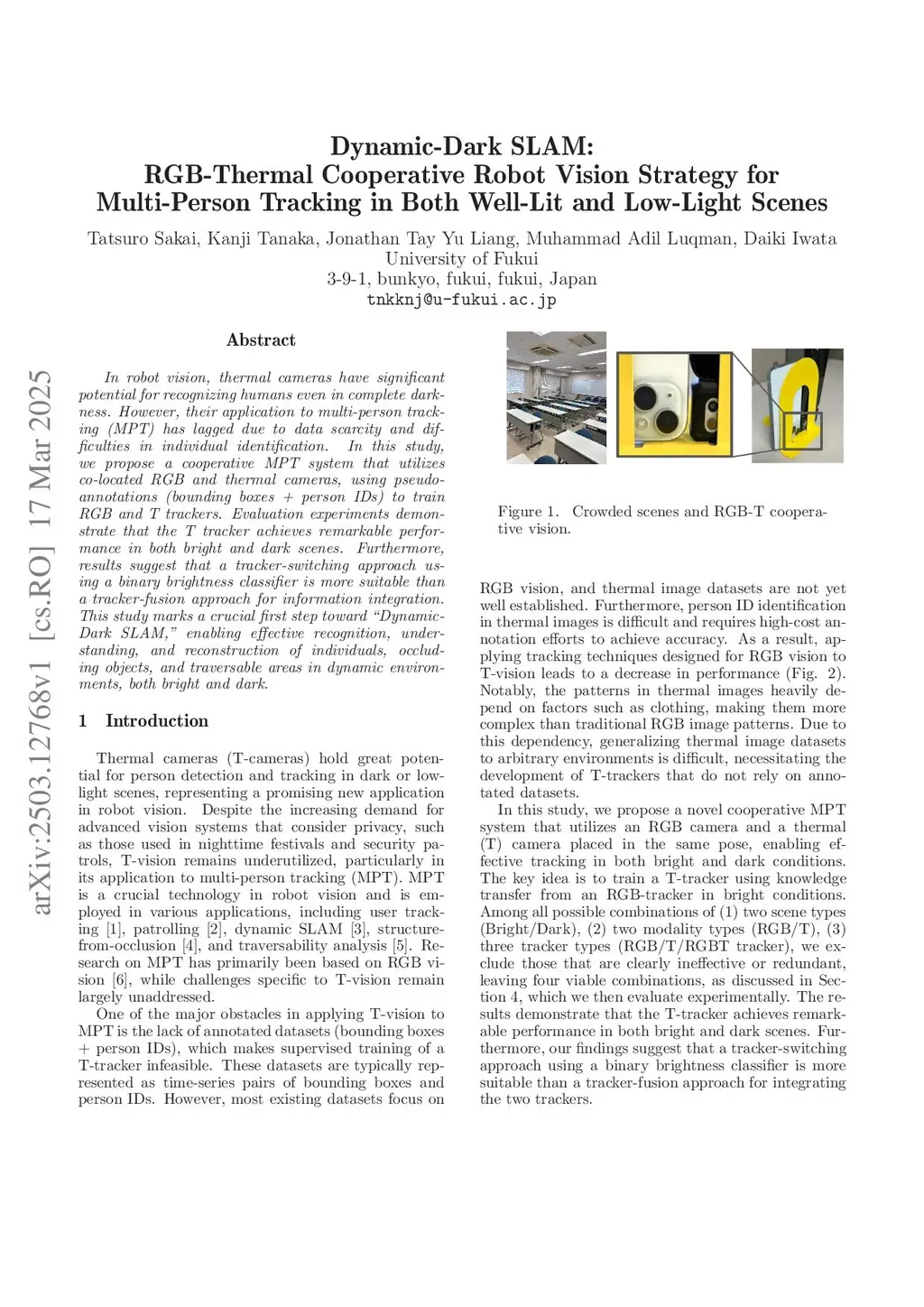
In robot vision, thermal cameras hold great potential for recognizing humans even in complete darkness. However, their application to multi-person tracking (MPT) has been limited due to data scarcity and the inherent difficulty of distinguishing individuals. In this study, we propose a cooperative MPT system that utilizes co-located RGB and thermal cameras, where pseudo-annotations (bounding boxes and person IDs) are used to train both RGB and thermal trackers. Evaluation experiments demonstrate that the thermal tracker performs robustly in both bright and dark environments. Moreover, the results suggest that a tracker-switching strategy -- guided by a binary brightness classifier -- is more effective for information integration than a tracker-fusion approach. As an application example, we present an image change pattern recognition (ICPR) method, the ``human-as-landmark,'' which combines two key properties: the thermal recognizability of humans in dark environments and the rich landmark characteristics -- appearance, geometry, and semantics -- of static objects (occluders). Whereas conventional SLAM focuses on mapping static landmarks in well-lit environments, the present study takes a first step toward a new Human-Only SLAM paradigm, ``Dynamic-Dark SLAM,'' which aims to map even dynamic landmarks in complete darkness. Additionally, this study demonstrates that knowledge transfer between thermal and depth modalities enables reliable person tracking using low-resolution 3D LiDAR data without RGB input, contributing an important advance toward cross-robot SLAM systems.
View on arXiv