
KINESIS: Motion Imitation for Human Musculoskeletal Locomotion
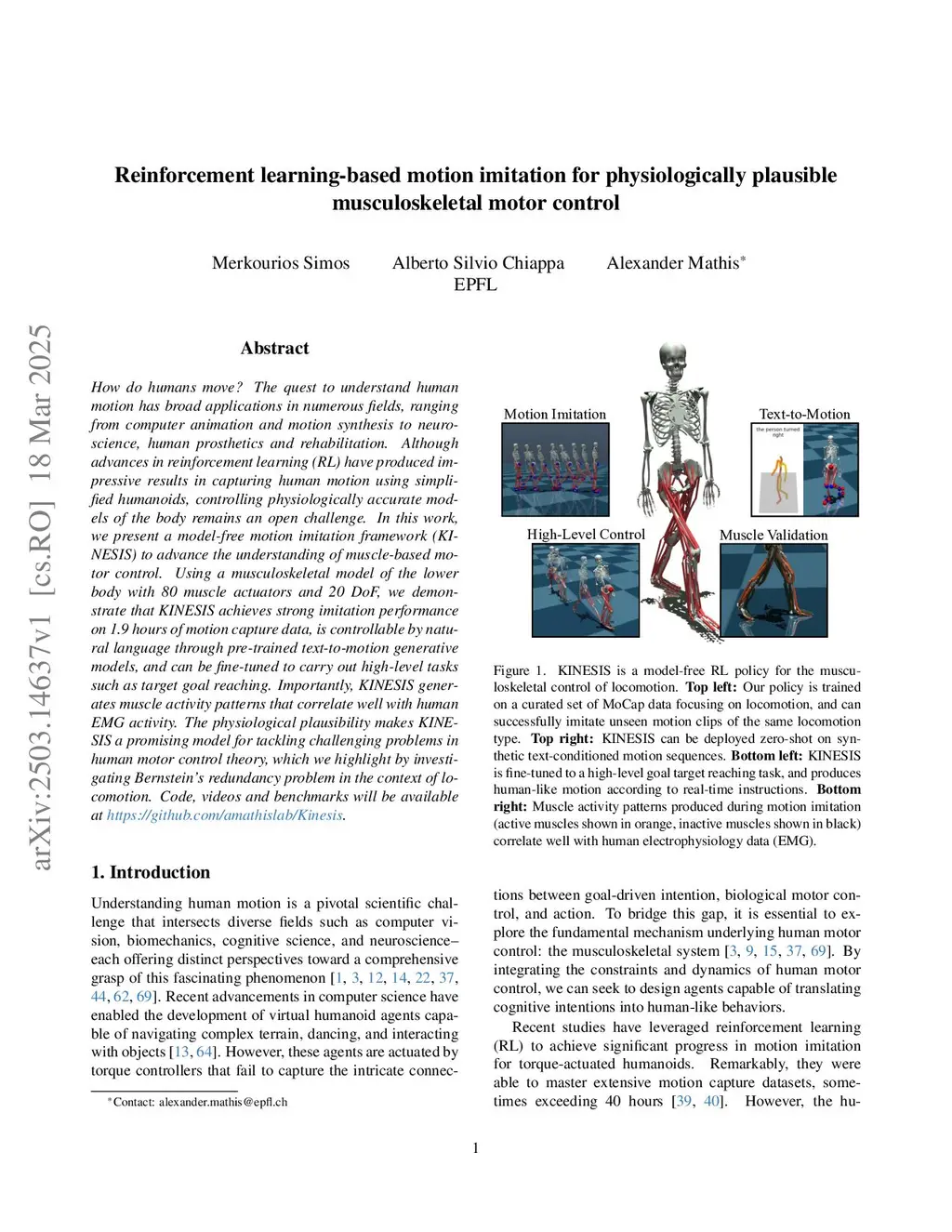
How do humans move? Advances in reinforcement learning (RL) have produced impressive results in capturing human motion using physics-based humanoid control. However, torque-controlled humanoids fail to model key aspects of human motor control such as biomechanical joint constraints \& non-linear and overactuated musculotendon control. We present KINESIS, a model-free motion imitation framework that tackles these challenges. KINESIS is trained on 1.8 hours of locomotion data and achieves strong motion imitation performance on unseen trajectories. Through a negative mining approach, KINESIS learns robust locomotion priors that we leverage to deploy the policy on several downstream tasks such as text-to-control, target point reaching, and football penalty kicks. Importantly, KINESIS learns to generate muscle activity patterns that correlate well with human EMG activity. We show that these results scale seamlessly across biomechanical model complexity, demonstrating control of up to 290 muscles. Overall, the physiological plausibility makes KINESIS a promising model for tackling challenging problems in human motor control. Code, videos and benchmarks are available atthis https URL.
View on arXiv