
PeRoI: A Pedestrian-Robot Interaction Dataset for Learning Avoidance, Neutrality, and Attraction Behaviors in Social Navigation
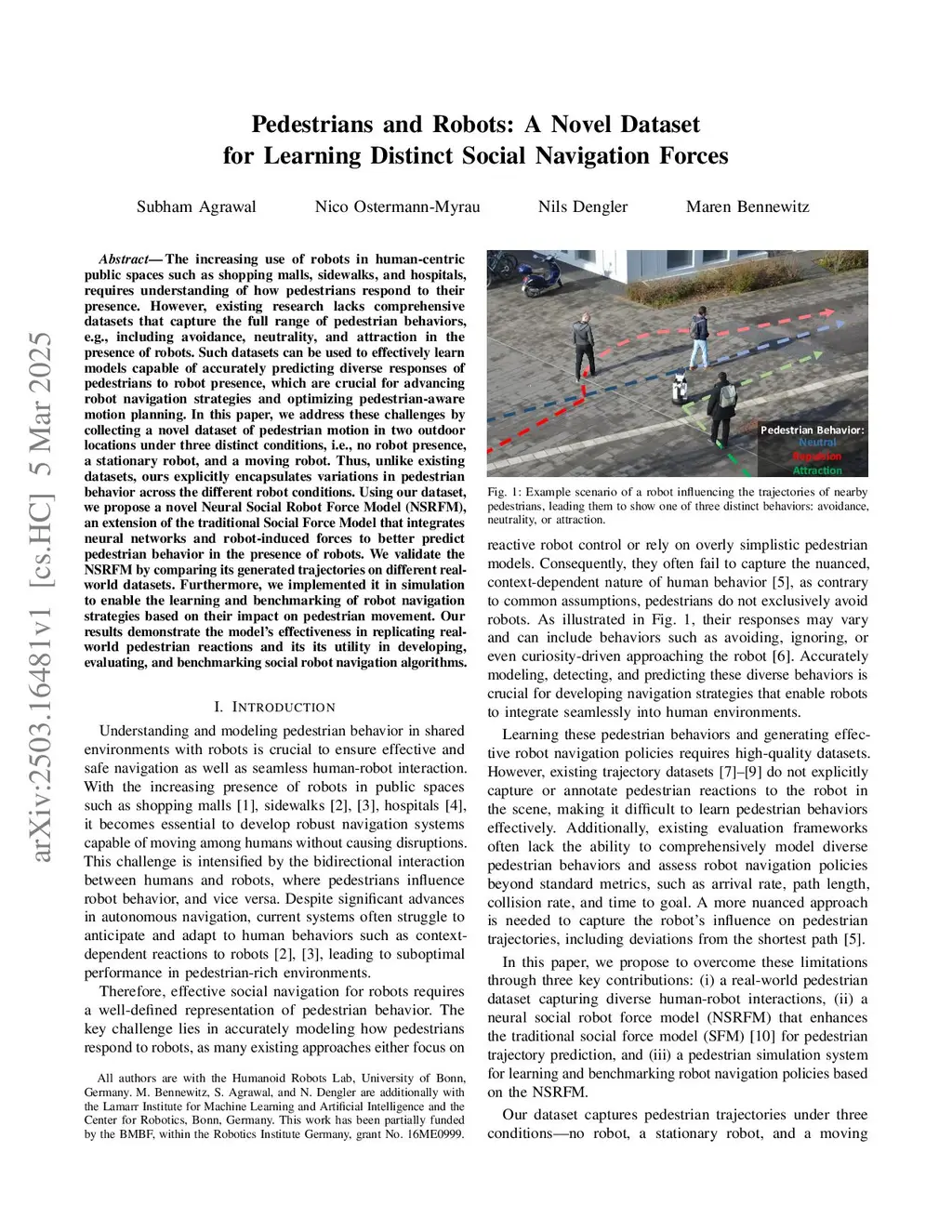
Robots are increasingly being deployed in public spaces such as shopping malls, sidewalks, and hospitals, where safe and socially aware navigation depends on anticipating how pedestrians respond to their presence. However, existing datasets rarely capture the full spectrum of robot-induced reactions, e.g., avoidance, neutrality, attraction, which limits progress in modeling these interactions. In this paper, we present the Pedestrian-Robot Interaction~(PeRoI) dataset that captures pedestrian motions categorized into attraction, neutrality, and repulsion across two outdoor sites under three controlled conditions: no robot present, with stationary robot, and with moving robot. This design explicitly reveals how pedestrian behavior varies across robot contexts, and we provide qualitative and quantitative comparisons to established state-of-the-art datasets. Building on these data, we propose the Neural Robot Social Force Model~(NeuRoSFM), an extension of the Social Force Model that integrates neural networks to augment inter-human dynamics with learned components and explicit robot-induced forces to better predict pedestrian motion in vicinity of robots. We evaluate NeuRoSFM by generating trajectories on multiple real-world datasets. The results demonstrate improved modeling of pedestrian-robot interactions, leading to better prediction accuracy, and highlight the value of our dataset and method for advancing socially aware navigation strategies in human-centered environments.
View on arXiv