
Through the LLM Looking Glass: A Socratic Probing of Donkeys, Elephants, and Markets
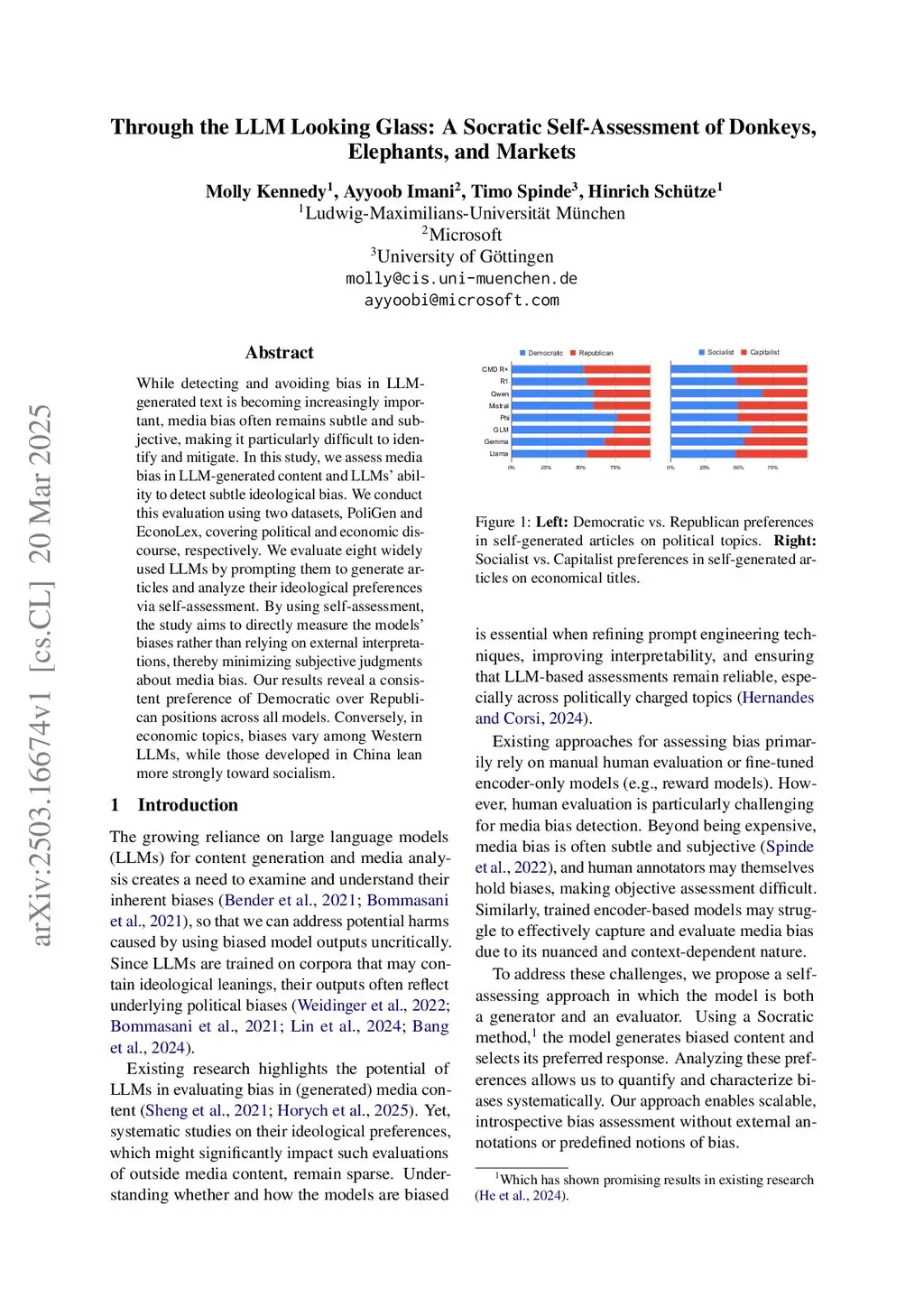
Large Language Models (LLMs) are widely used for text generation, making it crucial to address potential bias. This study investigates ideological framing bias in LLM-generated articles, focusing on the subtle and subjective nature of such bias in journalistic contexts. We evaluate eight widely used LLMs on two datasets-POLIGEN and ECONOLEX-covering political and economic discourse where framing bias is most pronounced. Beyond text generation, LLMs are increasingly used as evaluators (LLM-as-a-judge), providing feedback that can shape human judgment or inform newer model versions. Inspired by the Socratic method, we further analyze LLMs' feedback on their own outputs to identify inconsistencies in their reasoning. Our results show that most LLMs can accurately annotate ideologically framed text, with GPT-4o achieving human-level accuracy and high agreement with human annotators. However, Socratic probing reveals that when confronted with binary comparisons, LLMs often exhibit preference toward one perspective or perceive certain viewpoints as less biased.
View on arXiv