
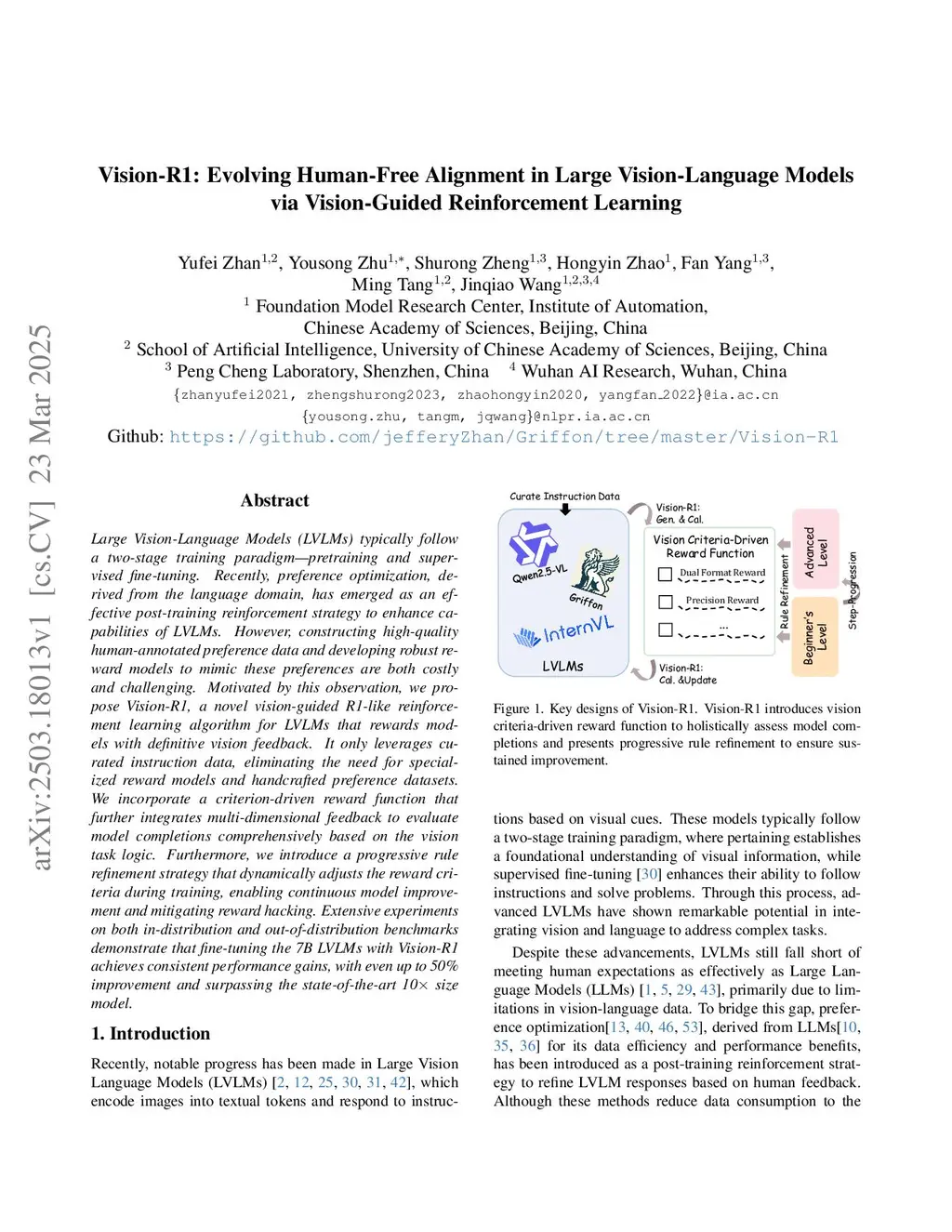
Large Vision-Language Models (LVLMs) typically follow a two-stage training paradigm-pretraining and supervised fine-tuning. Recently, preference optimization, derived from the language domain, has emerged as an effective post-training reinforcement strategy to enhance capabilities of LVLMs. However, constructing high-quality human-annotated preference data and developing robust reward models to mimic these preferences are both costly and challenging. Motivated by this observation, we propose Vision-R1, a novel vision-guided R1-like reinforcement learning algorithm for LVLMs that rewards models with definitive vision feedback. It only leverages curated instruction data, eliminating the need for specialized reward models and handcrafted preference datasets. We incorporate a criterion-driven reward function that further integrates multi-dimensional feedback to evaluate model completions comprehensively based on the vision task logic. Furthermore, we introduce a progressive rule refinement strategy that dynamically adjusts the reward criteria during training, enabling continuous model improvement and mitigating reward hacking. Extensive experiments on both in-distribution and out-of-distribution benchmarks demonstrate that fine-tuning the 7B LVLMs with Vision-R1 achieves consistent performance gains, with even up to 50% improvement and surpassing the state-of-the-art 10x size model.
View on arXiv