
Flying Vines: Design, Modeling, and Control of a Soft Aerial Robotic Arm
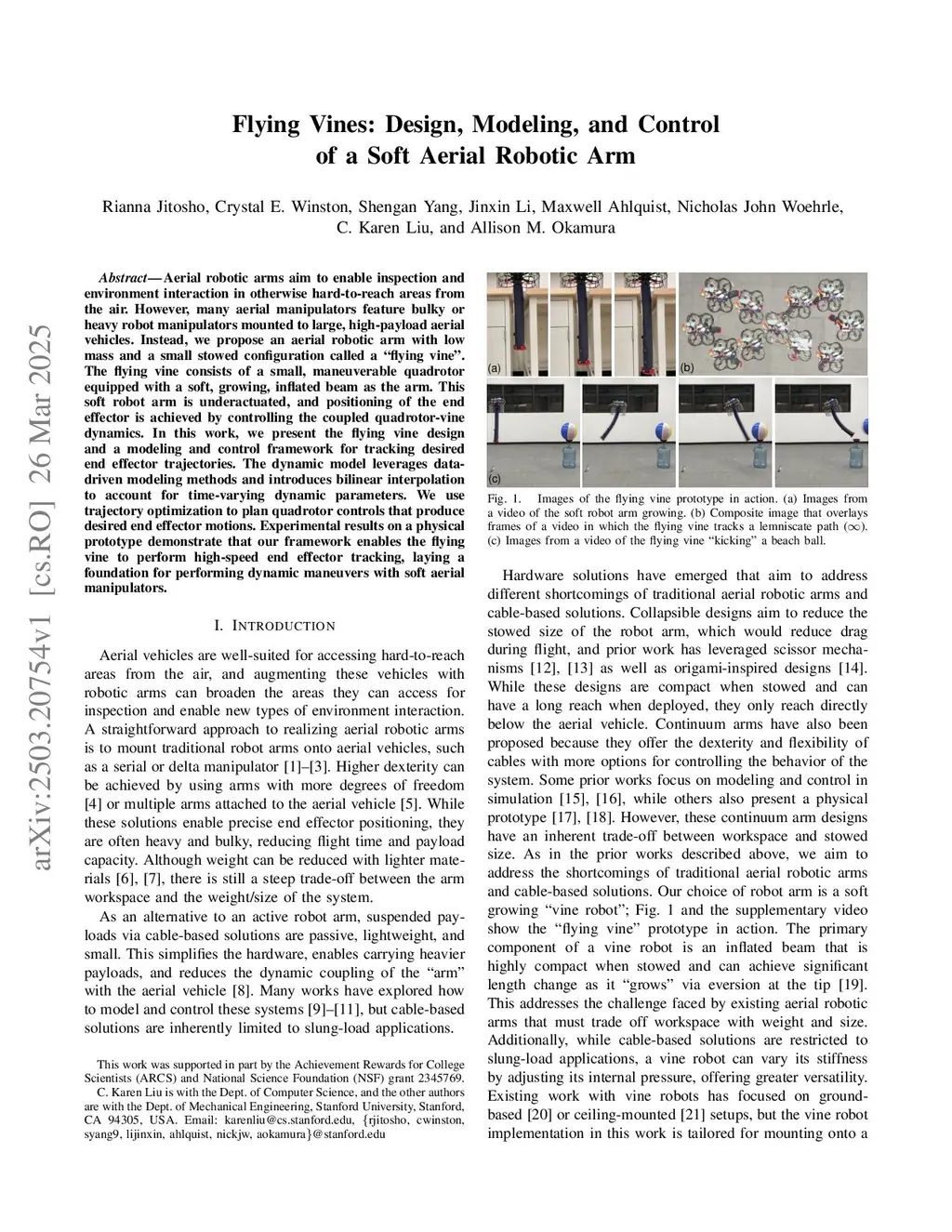
Aerial robotic arms aim to enable inspection and environment interaction in otherwise hard-to-reach areas from the air. However, many aerial manipulators feature bulky or heavy robot manipulators mounted to large, high-payload aerial vehicles. Instead, we propose an aerial robotic arm with low mass and a small stowed configuration called a "flying vine". The flying vine consists of a small, maneuverable quadrotor equipped with a soft, growing, inflated beam as the arm. This soft robot arm is underactuated, and positioning of the end effector is achieved by controlling the coupled quadrotor-vine dynamics. In this work, we present the flying vine design and a modeling and control framework for tracking desired end effector trajectories. The dynamic model leverages data-driven modeling methods and introduces bilinear interpolation to account for time-varying dynamic parameters. We use trajectory optimization to plan quadrotor controls that produce desired end effector motions. Experimental results on a physical prototype demonstrate that our framework enables the flying vine to perform high-speed end effector tracking, laying a foundation for performing dynamic maneuvers with soft aerial manipulators.
View on arXiv