
Graph-Structured Driven Dual Adaptation for Mitigating Popularity Bias
Main:12 Pages
7 Figures
Bibliography:2 Pages
Abstract
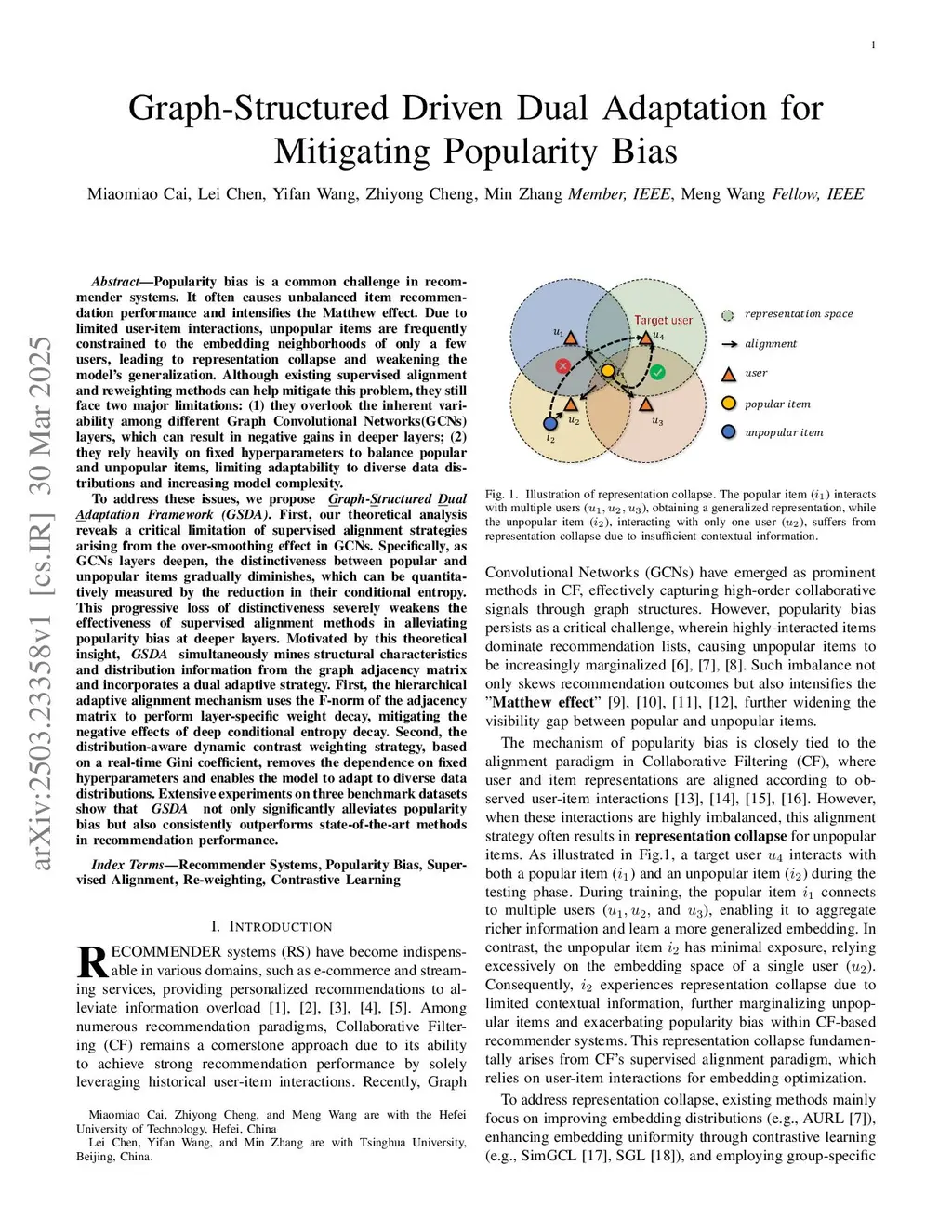
Popularity bias challenges recommender systems by causing uneven recommendation performance and amplifying the Matthew effect. Limited user-item interactions confine unpopular items within embedding neighborhoods of few users, leading to representation collapse and reduced model generalization. Existing supervised alignment and reweighting methods mitigate this bias but have key limitations: (1) ignoring inherent variability across Graph Convolutional Networks (GCNs) layers, causing negative effects in deeper layers; (2) reliance on fixed hyperparameters to balance item popularity, restricting adaptability and increasing complexity.
View on arXivComments on this paper