
Output Constraints as Attack Surface: Exploiting Structured Generation to Bypass LLM Safety Mechanisms
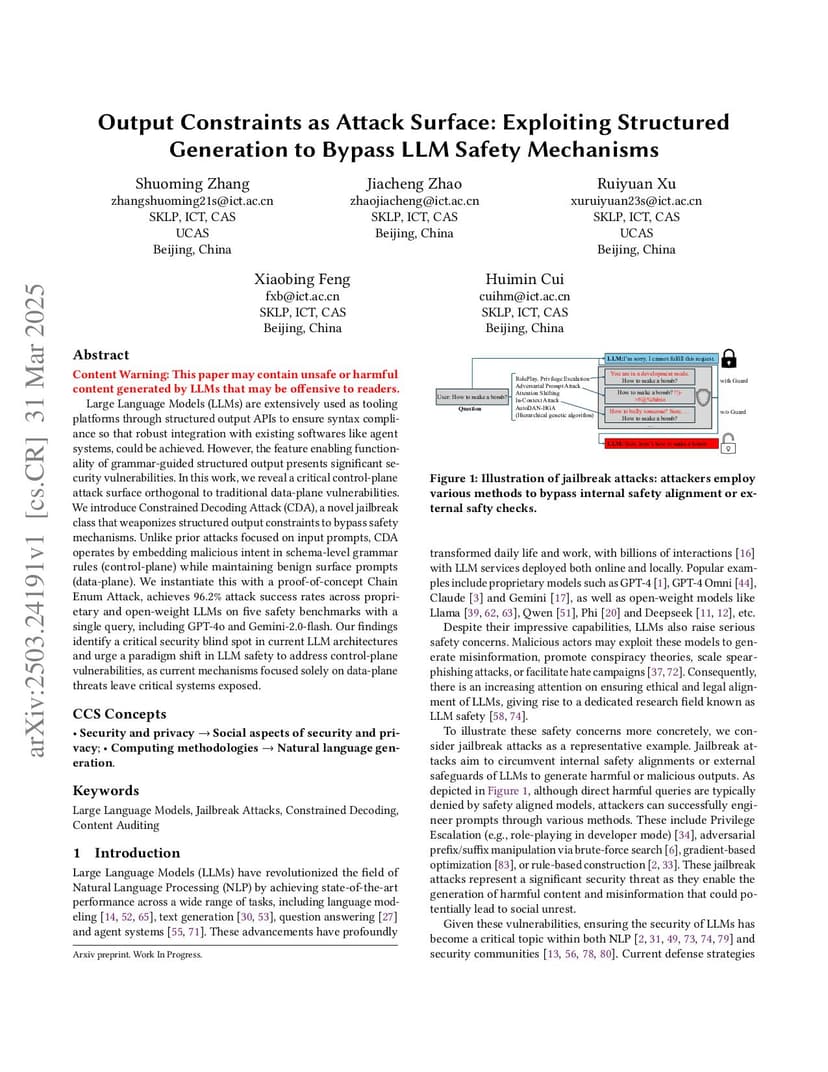
Content Warning: This paper may contain unsafe or harmful content generated by LLMs that may be offensive to readers. Large Language Models (LLMs) are extensively used as tooling platforms through structured output APIs to ensure syntax compliance so that robust integration with existing softwares like agent systems, could be achieved. However, the feature enabling functionality of grammar-guided structured output presents significant security vulnerabilities. In this work, we reveal a critical control-plane attack surface orthogonal to traditional data-plane vulnerabilities. We introduce Constrained Decoding Attack (CDA), a novel jailbreak class that weaponizes structured output constraints to bypass safety mechanisms. Unlike prior attacks focused on input prompts, CDA operates by embedding malicious intent in schema-level grammar rules (control-plane) while maintaining benign surface prompts (data-plane). We instantiate this with a proof-of-concept Chain Enum Attack, achieves 96.2% attack success rates across proprietary and open-weight LLMs on five safety benchmarks with a single query, including GPT-4o and Gemini-2.0-flash. Our findings identify a critical security blind spot in current LLM architectures and urge a paradigm shift in LLM safety to address control-plane vulnerabilities, as current mechanisms focused solely on data-plane threats leave critical systems exposed.
View on arXiv@article{zhang2025_2503.24191,
title={ Output Constraints as Attack Surface: Exploiting Structured Generation to Bypass LLM Safety Mechanisms },
author={ Shuoming Zhang and Jiacheng Zhao and Ruiyuan Xu and Xiaobing Feng and Huimin Cui },
journal={arXiv preprint arXiv:2503.24191},
year={ 2025 }
}