
From Continual Learning to SGD and Back: Better Rates for Continual Linear Models
- CLL
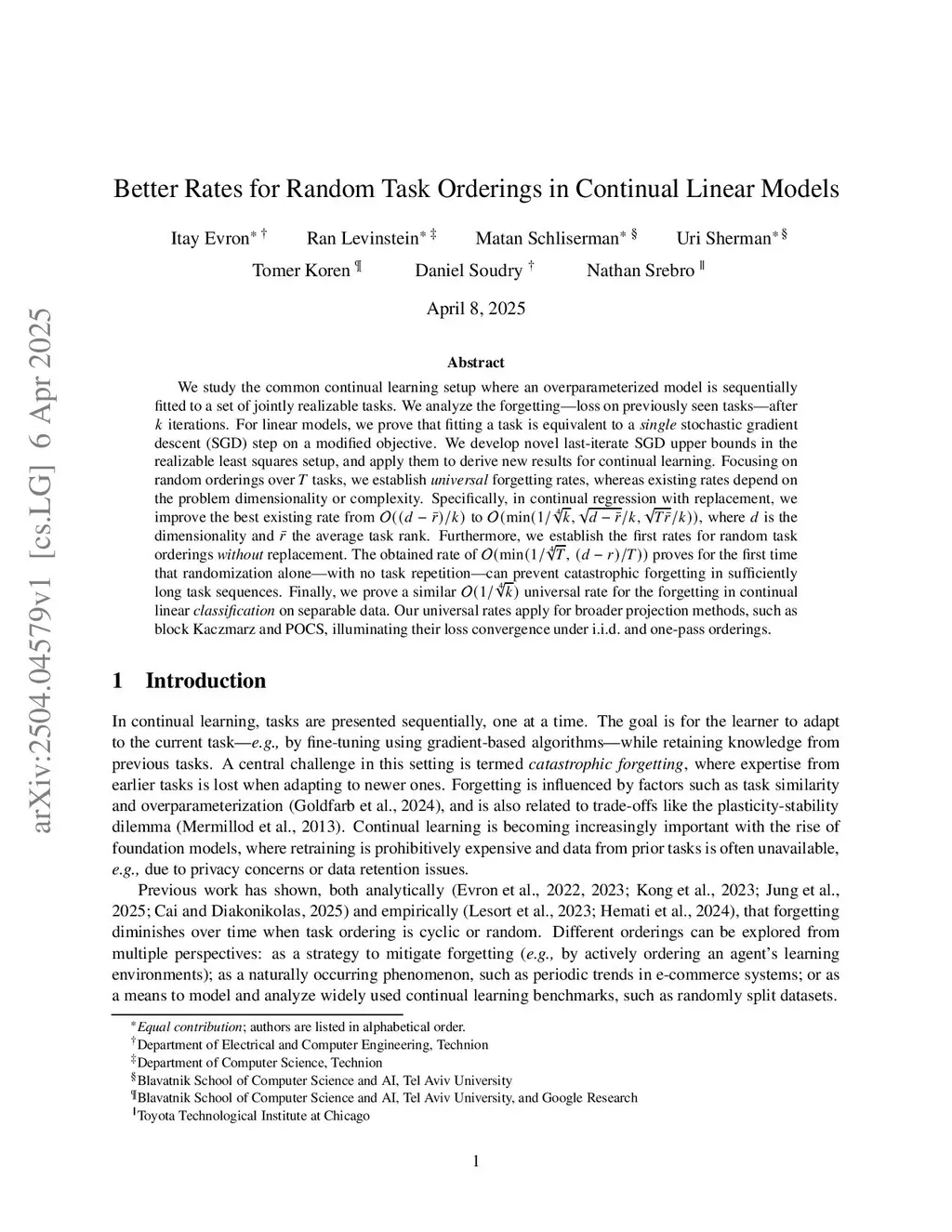
We theoretically study the common continual learning setup where an overparameterized model is sequentially fitted to a set of jointly realizable tasks. We analyze the forgetting, i.e., loss on previously seen tasks, after iterations. For continual linear models, we prove that fitting a task is equivalent to a single stochastic gradient descent (SGD) step on a modified objective. We develop novel last-iterate SGD upper bounds in the realizable least squares setup, which we then leverage to derive new results for continual learning. Focusing on random orderings over tasks, we establish universal forgetting rates, whereas existing rates depend on the problem dimensionality or complexity. Specifically, in continual regression with replacement, we improve the best existing rate from to , where is the dimensionality and the average task rank. Furthermore, we establish the first rate for random task orderings without replacement. The obtained rate of proves for the first time that randomization alone, with no task repetition, can prevent catastrophic forgetting in sufficiently long task sequences. Finally, we prove a matching forgetting rate for continual linear classification on separable data. Our universal rates apply for broader projection methods, such as block Kaczmarz and POCS, illuminating their loss convergence under i.i.d. and one-pass orderings.
View on arXiv