
DSwinIR: Rethinking Window-based Attention for Image Restoration
- ViT
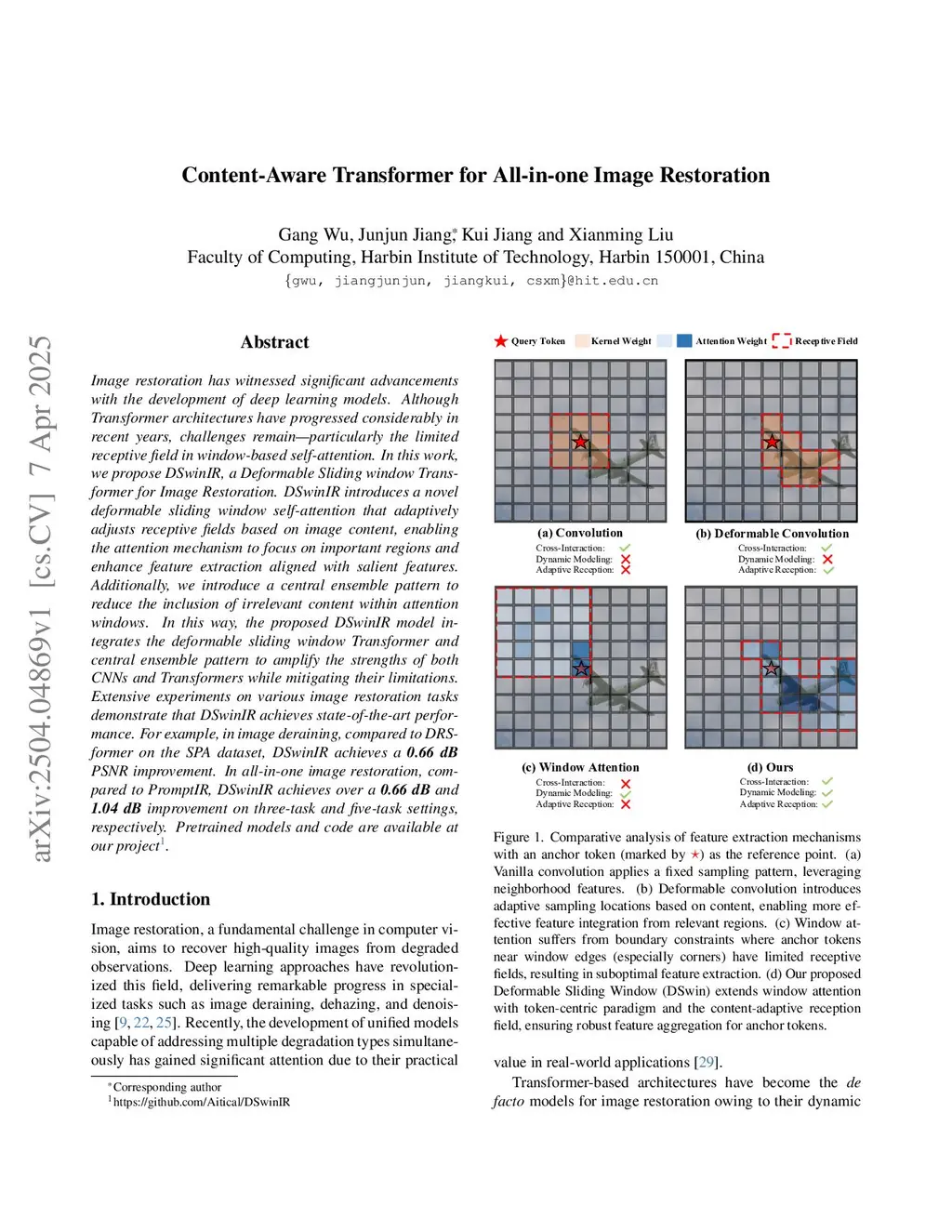
Image restoration has witnessed significant advancements with the development of deep learning models. Transformer-based models, particularly those using window-based self-attention, have become a dominant force. However, their performance is constrained by the rigid, non-overlapping window partitioning scheme, which leads to \textit{insufficient feature interaction across windows and limited receptive fields}. This highlights the need for more adaptive and flexible attention mechanisms. In this paper, we propose the Deformable Sliding Window Transformer for Image Restoration (DSwinIR), a new attention mechanism: the {Deformable Sliding Window (DSwin) Attention}. {This mechanism introduces a token-centric and content-aware paradigm that moves beyond the grid and fixed window partition.} It comprises two complementary components. First, it replaces the rigid partitioning with a \textit{token-centric sliding window} paradigm, {making it effective at eliminating boundary artifacts}. Second, it incorporates a \textit{content-aware deformable sampling} strategy, which allows the attention mechanism to learn data-dependent offsets and actively shape its receptive field to focus on the most informative image regions. Extensive experiments show that DSwinIR achieves strong results, including state-of-the-art performance on several evaluated benchmarks. For instance, in all-in-one image restoration, our DSwinIR surpasses the most recent backbone GridFormer by 0.53 dB on the three-task benchmark and 0.87 dB on the five-task benchmark.
View on arXiv