
GARF: Learning Generalizable 3D Reassembly for Real-World Fractures
- AI4CE
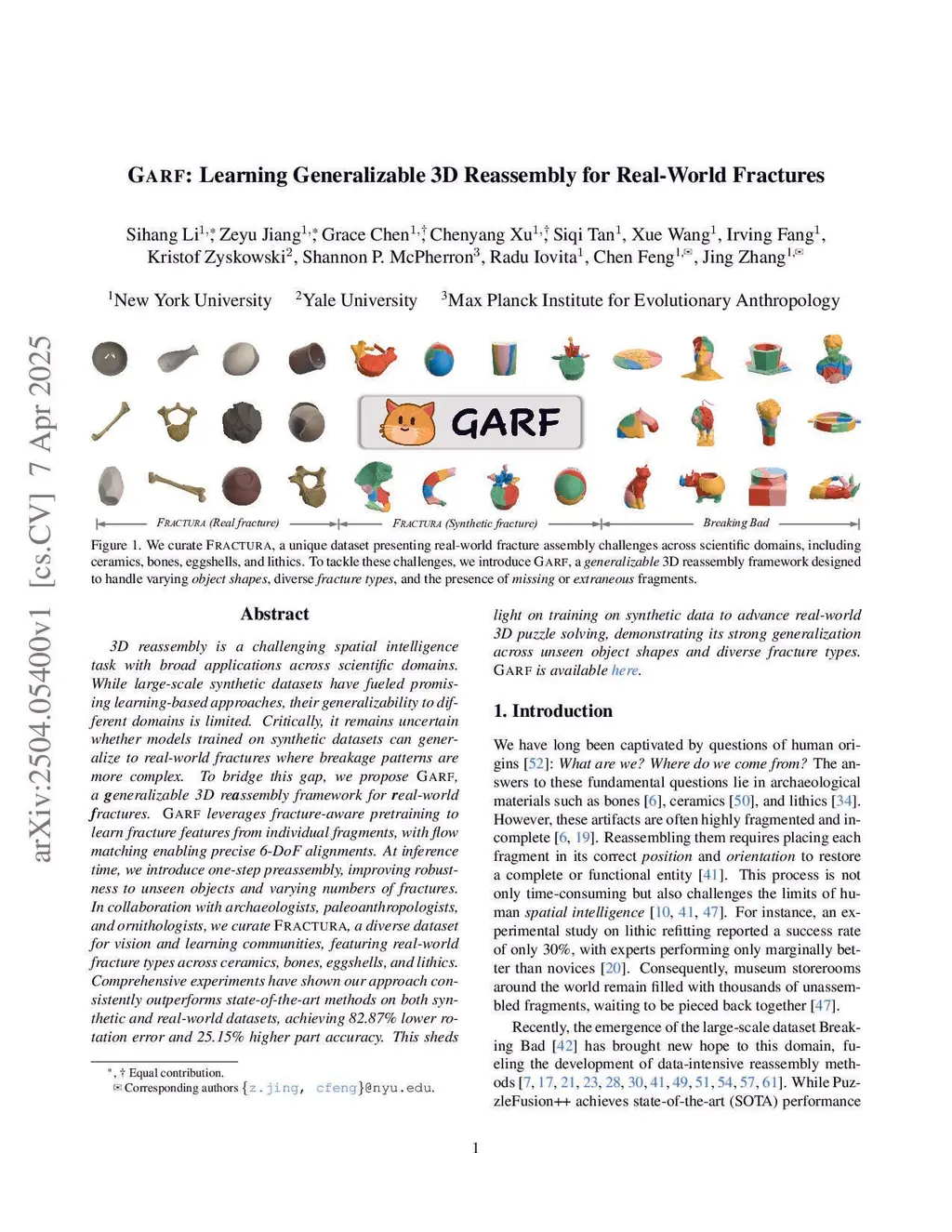
3D reassembly is a challenging spatial intelligence task with broad applications across scientific domains. While large-scale synthetic datasets have fueled promising learning-based approaches, their generalizability to different domains is limited. Critically, it remains uncertain whether models trained on synthetic datasets can generalize to real-world fractures where breakage patterns are more complex. To bridge this gap, we propose GARF, a generalizable 3D reassembly framework for real-world fractures. GARF leverages fracture-aware pretraining to learn fracture features from individual fragments, with flow matching enabling precise 6-DoF alignments. At inference time, we introduce one-step preassembly, improving robustness to unseen objects and varying numbers of fractures. In collaboration with archaeologists, paleoanthropologists, and ornithologists, we curate Fractura, a diverse dataset for vision and learning communities, featuring real-world fracture types across ceramics, bones, eggshells, and lithics. Comprehensive experiments have shown our approach consistently outperforms state-of-the-art methods on both synthetic and real-world datasets, achieving 82.87\% lower rotation error and 25.15\% higher part accuracy. This sheds light on training on synthetic data to advance real-world 3D puzzle solving, demonstrating its strong generalization across unseen object shapes and diverse fracture types. GARF's code, data and demo are available atthis https URL.
View on arXiv