
A Multimodal Recaptioning Framework to Account for Perceptual Diversity Across Languages in Vision-Language Modeling
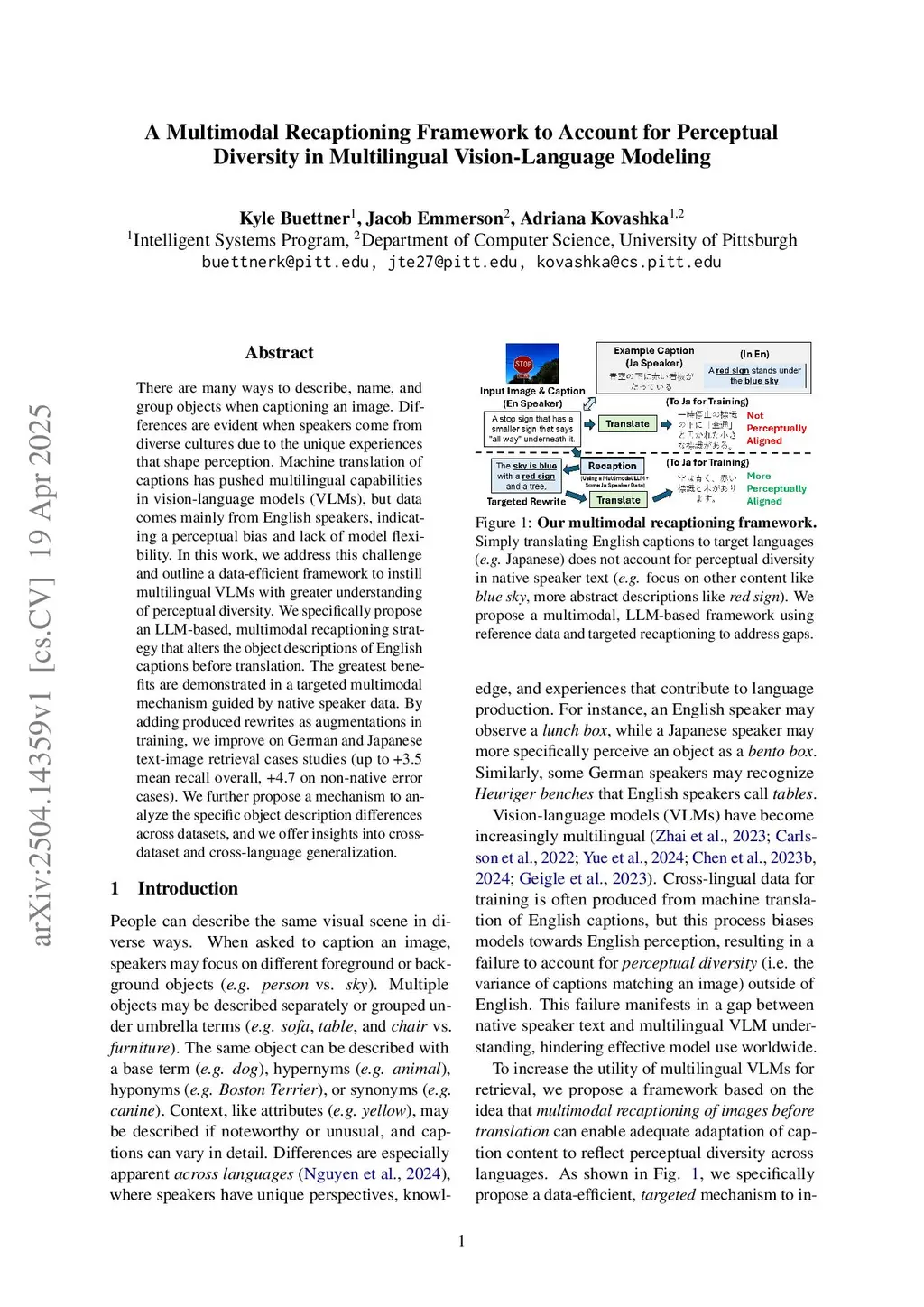
When captioning an image, people describe objects in diverse ways, such as by using different terms and/or including details that are perceptually noteworthy to them. Descriptions can be especially unique across languages and cultures. Modern vision-language models (VLMs) gain understanding of images with text in different languages often through training on machine translations of English captions. However, this process relies on input content written from the perception of English speakers, leading to a perceptual bias. In this work, we outline a framework to address this bias. We specifically use a small amount of native speaker data, nearest-neighbor example guidance, and multimodal LLM reasoning to augment captions to better reflect descriptions in a target language. When adding the resulting rewrites to multilingual CLIP finetuning, we improve on German and Japanese text-image retrieval case studies (up to +3.5 mean recall, +4.4 on native vs. translation errors). We also propose a mechanism to build understanding of object description variation across languages, and offer insights into cross-dataset and cross-language generalization.
View on arXiv