
MS-Occ: Multi-Stage LiDAR-Camera Fusion for 3D Semantic Occupancy Prediction
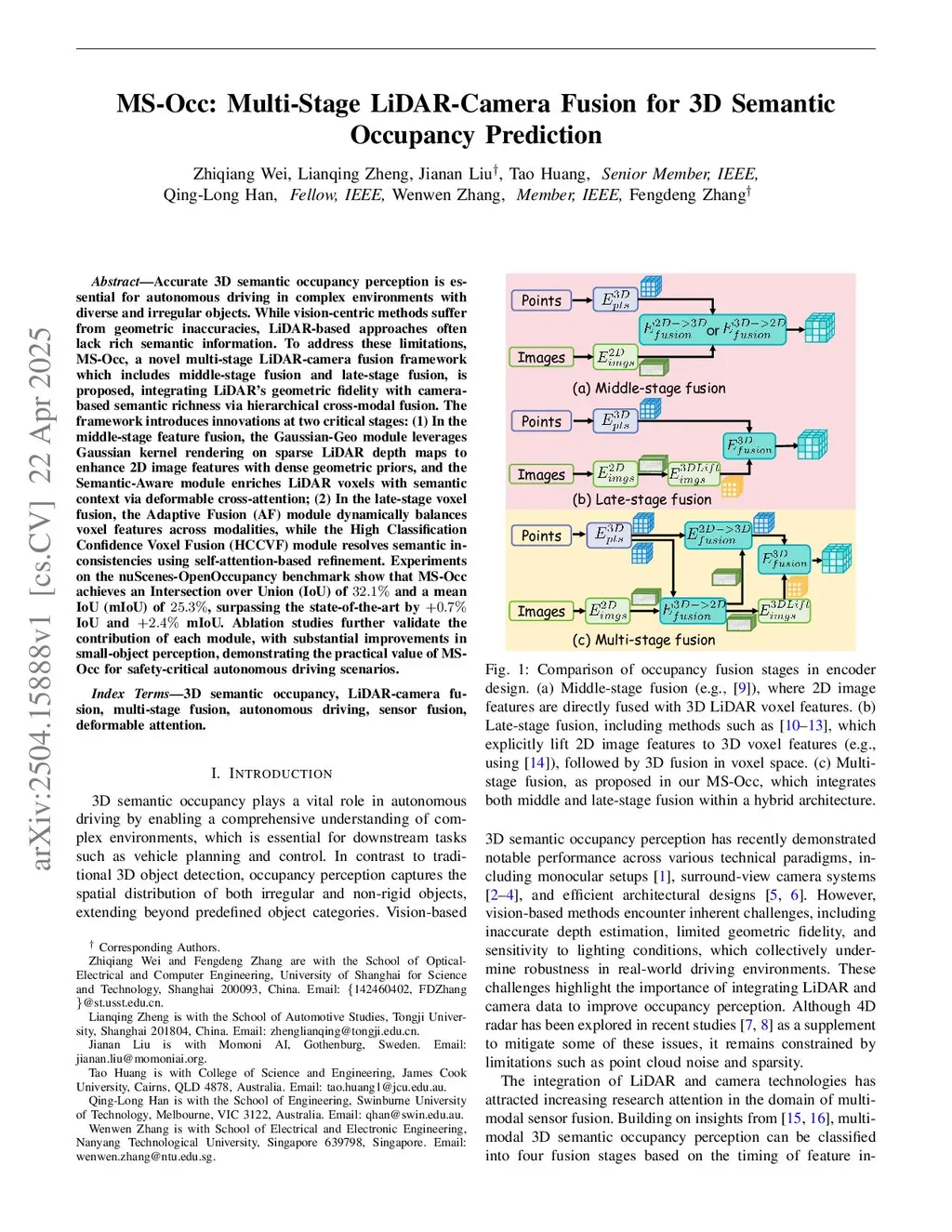
Accurate 3D semantic occupancy perception is essential for autonomous driving in complex environments with diverse and irregular objects. While vision-centric methods suffer from geometric inaccuracies, LiDAR-based approaches often lack rich semantic information. To address these limitations, MS-Occ, a novel multi-stage LiDAR-camera fusion framework which includes middle-stage fusion and late-stage fusion, is proposed, integrating LiDAR's geometric fidelity with camera-based semantic richness via hierarchical cross-modal fusion. The framework introduces innovations at two critical stages: (1) In the middle-stage feature fusion, the Gaussian-Geo module leverages Gaussian kernel rendering on sparse LiDAR depth maps to enhance 2D image features with dense geometric priors, and the Semantic-Aware module enriches LiDAR voxels with semantic context via deformable cross-attention; (2) In the late-stage voxel fusion, the Adaptive Fusion (AF) module dynamically balances voxel features across modalities, while the High Classification Confidence Voxel Fusion (HCCVF) module resolves semantic inconsistencies using self-attention-based refinement. Experiments on two large-scale benchmarks demonstrate state-of-the-art performance. On nuScenes-OpenOccupancy, MS-Occ achieves an Intersection over Union (IoU) of 32.1% and a mean IoU (mIoU) of 25.3%, surpassing the state-of-the-art by +0.7% IoU and +2.4% mIoU. Furthermore, on the SemanticKITTI benchmark, our method achieves a new state-of-the-art mIoU of 24.08%, robustly validating its generalizationthis http URLstudies further confirm the effectiveness of each individual module, highlighting substantial improvements in the perception of small objects and reinforcing the practical value of MS-Occ for safety-critical autonomous driving scenarios.
View on arXiv