
Federated EndoViT: Pretraining Vision Transformers via Federated Learning on Endoscopic Image Collections
- FedMLMedIm
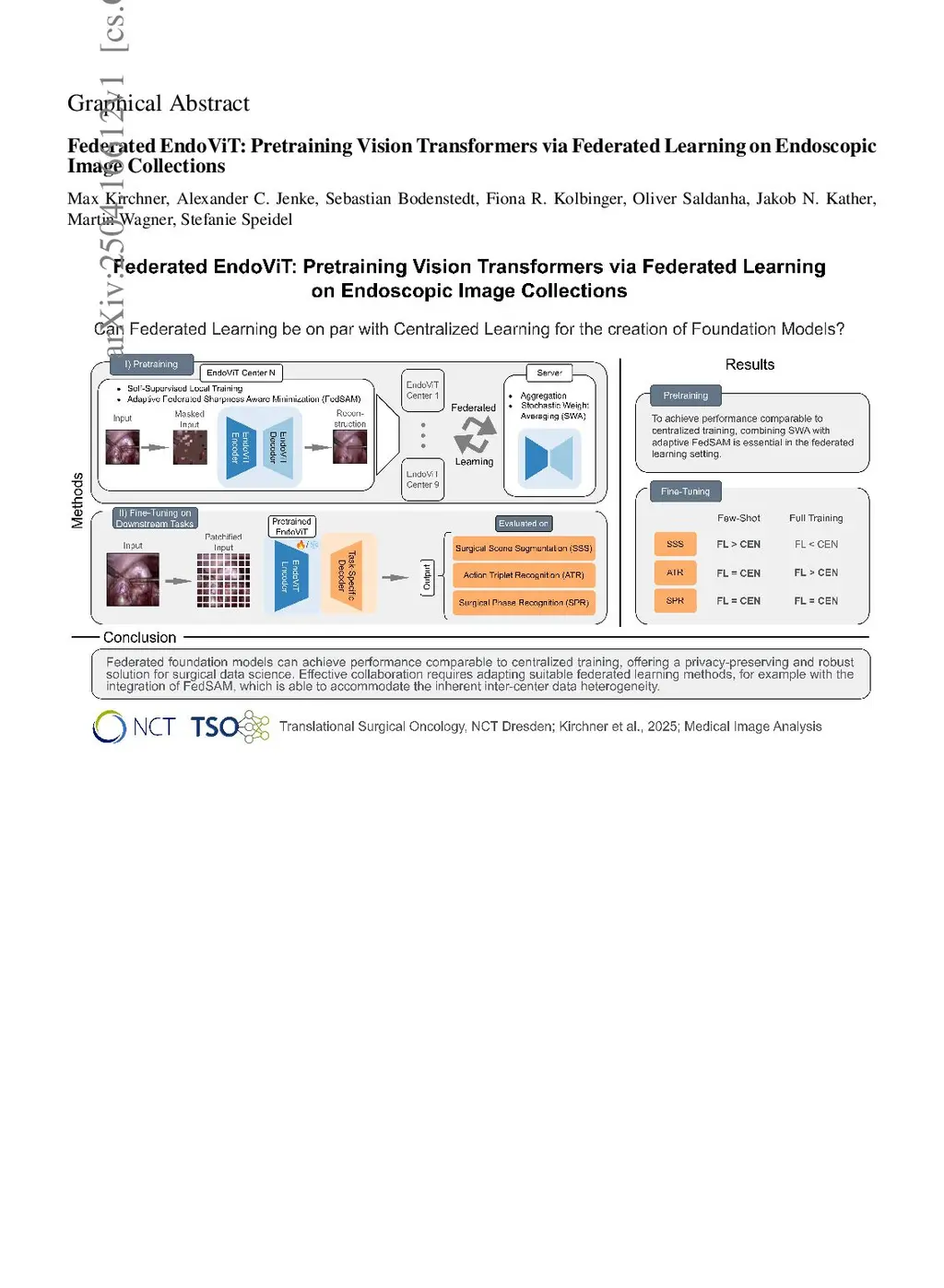
Purpose: Data privacy regulations hinder the creation of generalizable foundation models (FMs) for surgery by preventing multi-institutional data aggregation. This study investigates federated learning (FL) as a privacy-preserving solution to collaboratively train robust surgical FMs. Methods: We introduce Federated EndoViT (FL-EndoViT), a federated framework that validates the Masked Autoencoder (MAE) pretraining strategy in a decentralized surgical setting. To ensure convergence under severe data heterogeneity, the architecture integrates adaptive Sharpness-Aware Minimization (FedSAM). Pretrained on the large-scale Endo700k dataset, FL-EndoViT is evaluated against a centralized baseline on different tasks including scene segmentation, action recognition, and phase recognition. Results: FedSAM is critical for successful pretraining, overcoming the convergence failures of standard federated methods. The resulting FL-EndoViT performs comparably to its centralized counterpart, with significant advantages in data-scarce, high-resolution segmentation and generalization to new surgical events. We also establish that full, end-to-end fine-tuning is necessary for optimal performance. Conclusion: This work validates FL with adaptive optimization as a viable paradigm for creating robust, privacy-preserving surgical FMs. Our findings provide a scalable framework for collaborative Surgical Data Science and underscore the optimizer's critical role in handling data heterogeneity. Future work should explore video-based models to incorporate spatiotemporal dynamics.
View on arXiv