
S2Vec: Self-Supervised Geospatial Embeddings for the Built Environment
- SSLAI4TS
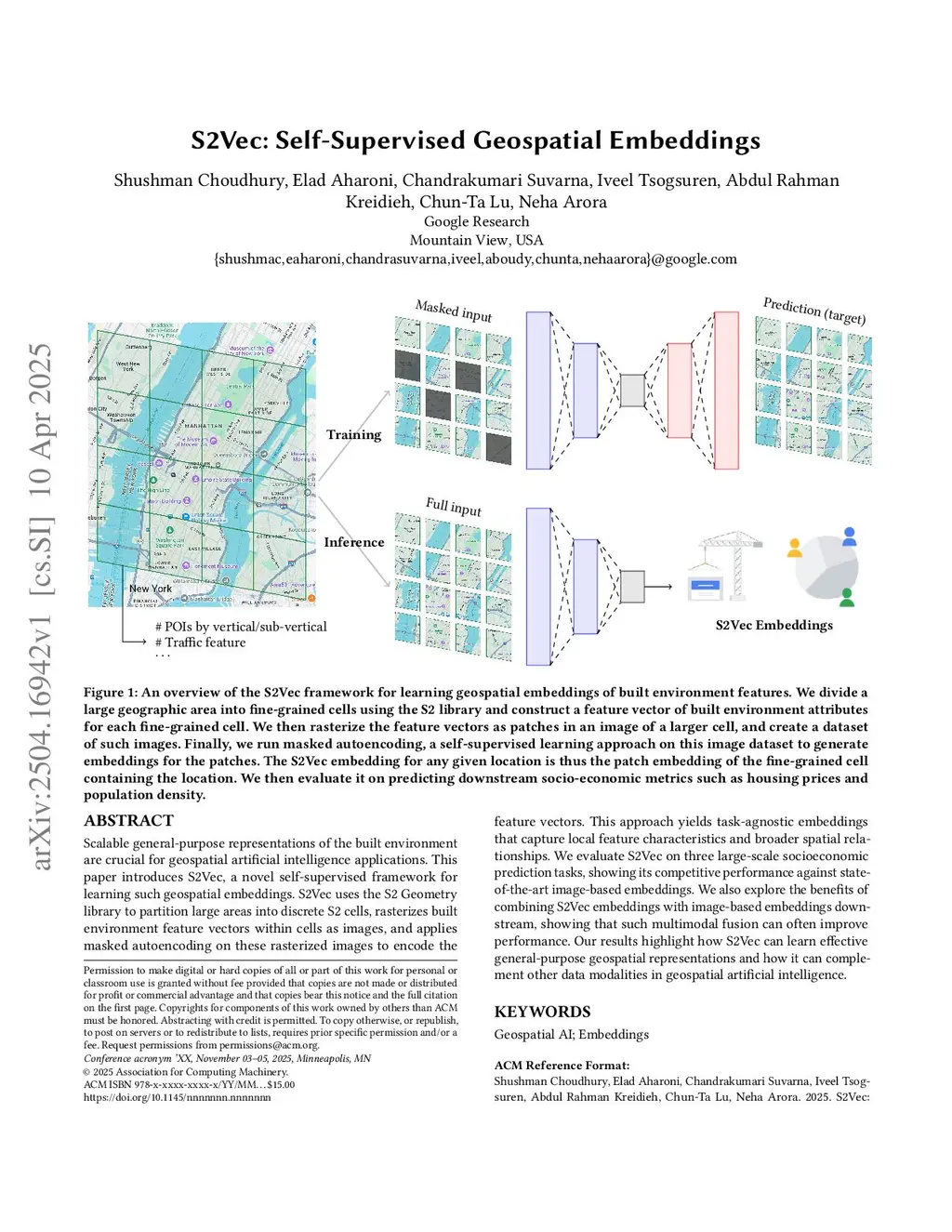
Scalable general-purpose representations of the built environment are crucial for geospatial artificial intelligence applications. This paper introduces S2Vec, a novel self-supervised framework for learning such geospatial embeddings. S2Vec uses the S2 Geometry library to partition large areas into discrete S2 cells, rasterizes built environment feature vectors within cells as images, and applies masked autoencoding on these rasterized images to encode the feature vectors. This approach yields task-agnostic embeddings that capture local feature characteristics and broader spatial relationships. We evaluate S2Vec on several large-scale geospatial prediction tasks, both random train/test splits (interpolation) and zero-shot geographic adaptation (extrapolation). Our experiments show S2Vec's competitive performance against several baselines on socioeconomic tasks, especially the geographic adaptation variant, with room for improvement on environmental tasks. We also explore combining S2Vec embeddings with image-based embeddings downstream, showing that such multimodal fusion can often improve performance. Our findings highlight how S2Vec can learn effective general-purpose geospatial representations of the built environment features it is provided, and how it can complement other data modalities in geospatial artificial intelligence.
View on arXiv