
Geometric Gait Optimization for Kinodynamic Systems Using a Lie Group Integrator
- AI4CE
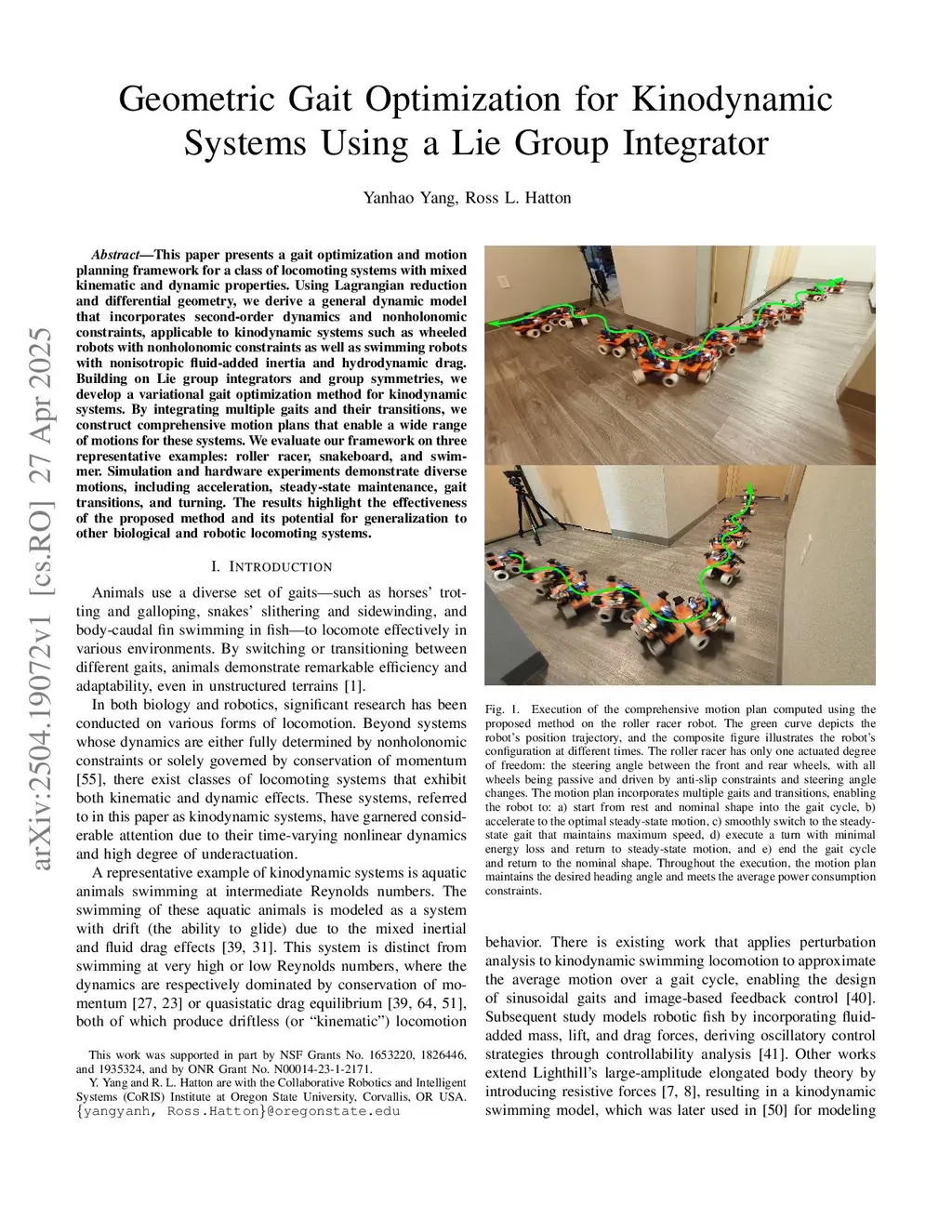
This paper presents a gait optimization and motion planning framework for a class of locomoting systems with mixed kinematic and dynamic properties. Using Lagrangian reduction and differential geometry, we derive a general dynamic model that incorporates second-order dynamics and nonholonomic constraints, applicable to kinodynamic systems such as wheeled robots with nonholonomic constraints as well as swimming robots with nonisotropic fluid-added inertia and hydrodynamic drag. Building on Lie group integrators and group symmetries, we develop a variational gait optimization method for kinodynamic systems. By integrating multiple gaits and their transitions, we construct comprehensive motion plans that enable a wide range of motions for these systems. We evaluate our framework on three representative examples: roller racer, snakeboard, and swimmer. Simulation and hardware experiments demonstrate diverse motions, including acceleration, steady-state maintenance, gait transitions, and turning. The results highlight the effectiveness of the proposed method and its potential for generalization to other biological and robotic locomoting systems.
View on arXiv