
AlphaFuse: Learn ID Embeddings for Sequential Recommendation in Null Space of Language Embeddings
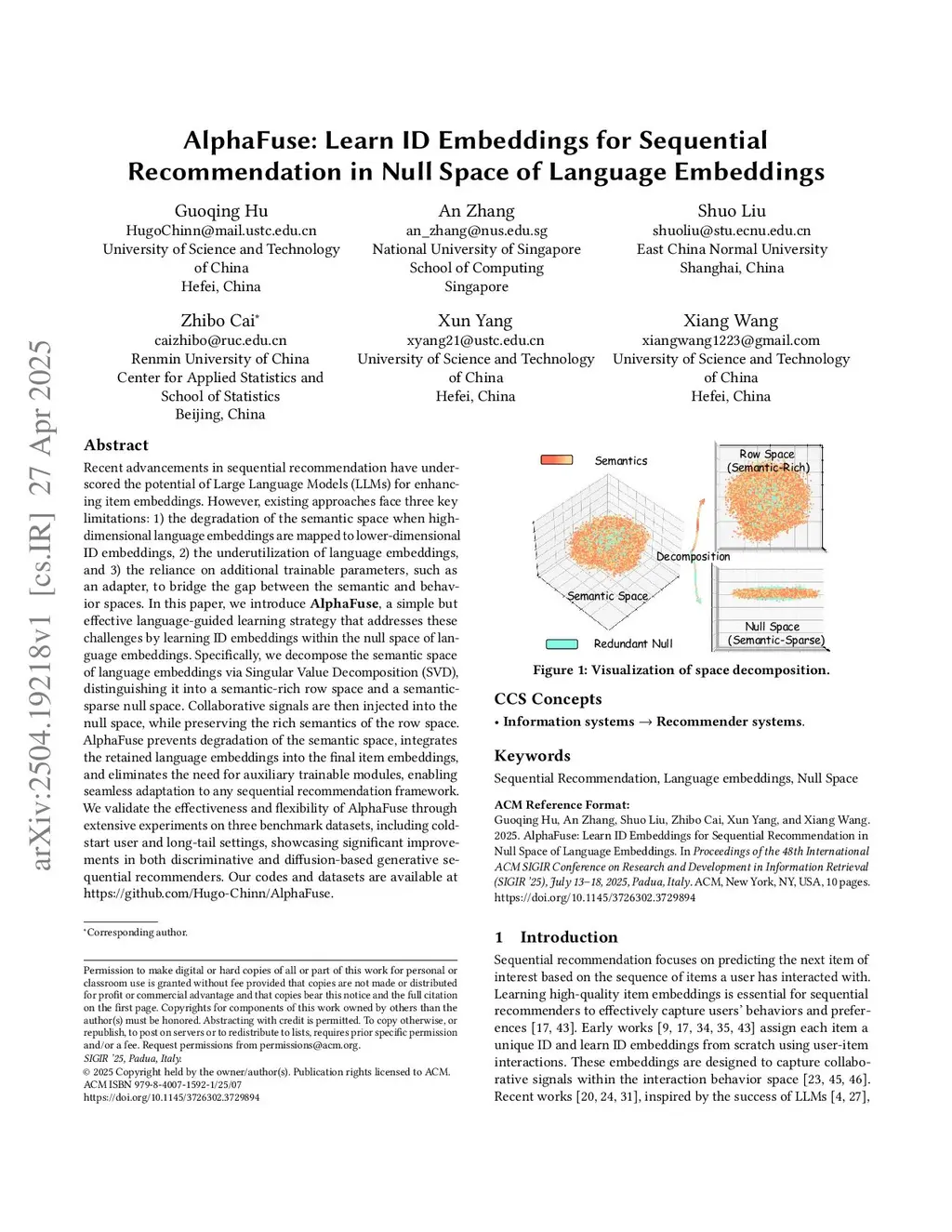
Recent advancements in sequential recommendation have underscored the potential of Large Language Models (LLMs) for enhancing item embeddings. However, existing approaches face three key limitations: 1) the degradation of the semantic space when high-dimensional language embeddings are mapped to lower-dimensional ID embeddings, 2) the underutilization of language embeddings, and 3) the reliance on additional trainable parameters, such as an adapter, to bridge the gap between the semantic and behavior spaces. In this paper, we introduce AlphaFuse, a simple but effective language-guided learning strategy that addresses these challenges by learning ID embeddings within the null space of language embeddings. Specifically, we decompose the semantic space of language embeddings via Singular Value Decomposition (SVD), distinguishing it into a semantic-rich row space and a semantic-sparse null space. Collaborative signals are then injected into the null space, while preserving the rich semantics of the row space. AlphaFuse prevents degradation of the semantic space, integrates the retained language embeddings into the final item embeddings, and eliminates the need for auxiliary trainable modules, enabling seamless adaptation to any sequential recommendation framework. We validate the effectiveness and flexibility of AlphaFuse through extensive experiments on three benchmark datasets, including cold-start user and long-tail settings, showcasing significant improvements in both discriminative and diffusion-based generative sequential recommenders. Our codes and datasets are available atthis https URL.
View on arXiv