
Adversarial Shallow Watermarking
- WIGMAAML
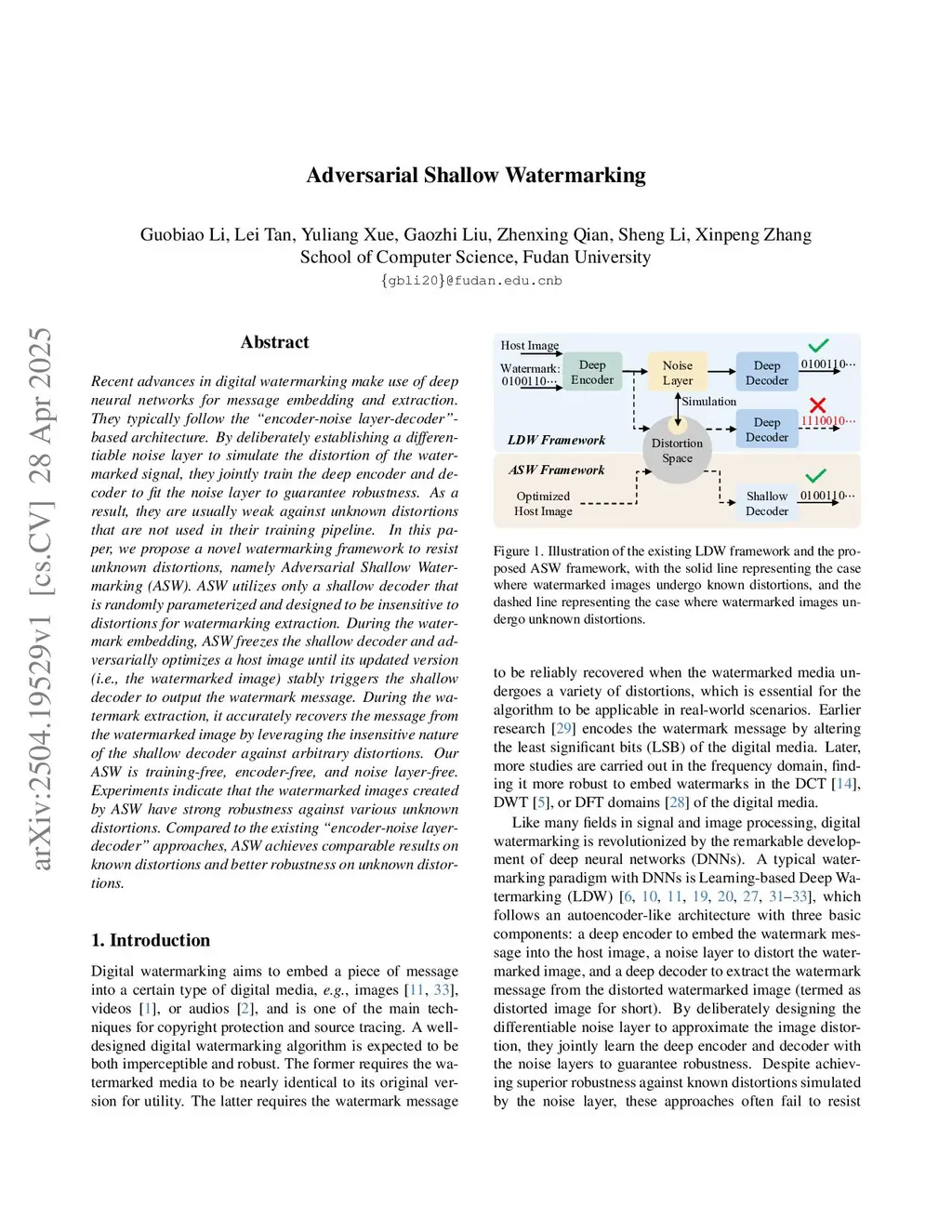
Recent advances in digital watermarking make use of deep neural networks for message embedding and extraction. They typically follow the ``encoder-noise layer-decoder''-based architecture. By deliberately establishing a differentiable noise layer to simulate the distortion of the watermarked signal, they jointly train the deep encoder and decoder to fit the noise layer to guarantee robustness. As a result, they are usually weak against unknown distortions that are not used in their training pipeline. In this paper, we propose a novel watermarking framework to resist unknown distortions, namely Adversarial Shallow Watermarking (ASW). ASW utilizes only a shallow decoder that is randomly parameterized and designed to be insensitive to distortions for watermarking extraction. During the watermark embedding, ASW freezes the shallow decoder and adversarially optimizes a host image until its updated version (i.e., the watermarked image) stably triggers the shallow decoder to output the watermark message. During the watermark extraction, it accurately recovers the message from the watermarked image by leveraging the insensitive nature of the shallow decoder against arbitrary distortions. Our ASW is training-free, encoder-free, and noise layer-free. Experiments indicate that the watermarked images created by ASW have strong robustness against various unknown distortions. Compared to the existing ``encoder-noise layer-decoder'' approaches, ASW achieves comparable results on known distortions and better robustness on unknown distortions.
View on arXiv